
Introduction: The Turning Point of Machine Learning
In the winter of 2024, I visited a small artificial intelligence research lab hidden inside a quiet technology park in Bangalore. The team was working on a weather forecasting project for a remote Himalayan valley. They had limited computing resources and a very small budget. What they did have was ambition.
During one meeting, the lead engineer looked around the room and said, “If we choose the wrong framework today, we will spend the next year fixing what we could have avoided.” That sentence stayed with me.
That experience taught me that the right machine learning framework can make or break a project. As we step into 2025, the landscape of artificial intelligence is evolving rapidly. Frameworks are not just tools anymore; they are ecosystems that define the speed, quality, and scalability of innovation.
So let us explore the Top 10 Machine Learning Frameworks to Use in 2025, understand their power, their purpose, and the kind of projects they are shaping across the world.
Why Frameworks Matter in 2025
Before we dive into the actual list of the top 10 machine learning frameworks to use in 2025, it is important to understand why this choice is so significant.
A machine learning framework is the foundation upon which models are built, trained, tested, and deployed. Choosing the right one determines how fast your model learns, how easily you can experiment, and how smoothly you can take your model from research to real-world application.
Let us understand the pillars that make these frameworks crucial in 2025.
- Ecosystem and Community
A framework with a strong community ensures constant updates, quick fixes, and endless learning resources. - Performance and Scalability
Models today have billions of parameters. The framework must scale efficiently across devices, servers, and clusters. - Research Flexibility
Frameworks that allow researchers to modify and customize components inspire faster innovation. - Interoperability
The ability to convert models into different formats like ONNX or CoreML allows flexibility across platforms. - Production and Longevity
The framework should be production-ready and supported by large organizations or open communities that keep it alive for the long term.
When we talk about the top 10 machine learning frameworks to use in 2025, these are the standards they must meet.
Top 10 Machine Learning Frameworks
1. TensorFlow with Keras
TensorFlow remains one of the strongest contenders in any list of the top 10 machine learning frameworks to use in 2025. It is backed by Google and trusted by industries across the world.
During the Himalayan valley project, one of the biggest challenges was deploying models to mobile devices with weak connectivity. TensorFlow Lite allowed the team to compress and optimize models that ran perfectly on edge sensors. That moment made everyone realize why TensorFlow remains a giant even in 2025.
Why it matters in 2025:
- Huge community and extensive documentation
- Smooth production pipelines through TensorFlow Extended
- Excellent support for mobile and embedded deployment
- TensorBoard for visualization and model tracking
TensorFlow’s maturity ensures it remains one of the most reliable machine learning frameworks in 2025 for both research and production.
2. PyTorch
If TensorFlow is the corporate workhorse, PyTorch is the artist. It is flexible, expressive, and intuitive. It is loved by researchers and dominates academic papers and experimental projects.
A team I once mentored built an audio recognition model in PyTorch. They loved how easy it was to experiment, debug, and visualize results. Within weeks they had something ready to demo. That level of creativity is what makes PyTorch shine.
Why it dominates the 2025 landscape:
- Clean and Pythonic code
- Ideal for rapid prototyping
- Hugely popular in research environments
- Integrated tools like TorchServe and TorchScript for production
PyTorch is not just part of the top 10 machine learning frameworks to use in 2025; for many innovators, it is number one.
3. JAX
JAX is the rising star that combines the simplicity of NumPy with the power of automatic differentiation and just-in-time compilation. It is one of the most promising frameworks for high-performance computing and research.
When I worked with a physics simulation team, we needed gradients of a complex numerical process. Only JAX made it elegant and efficient. We wrote the code once and ran it across GPUs effortlessly.
Why JAX deserves a place in the 2025 list:
- Exceptional performance with automatic differentiation
- Perfect for large-scale mathematical research
- Integrates easily with Flax and Haiku for model building
JAX stands as one of the most innovative machine learning frameworks to use in 2025, built for people who want precision, speed, and control.
4. Hugging Face Transformers
In 2025, language models and transformers rule artificial intelligence. The Hugging Face Transformers library has become a core ecosystem, not just a toolkit.
It provides ready-made models for natural language processing, image recognition, audio understanding, and even generative AI. What makes it special is accessibility.
A small startup can fine-tune a billion-parameter model in hours using Hugging Face. During a personal project on environmental text summarization, we used their trainer API and achieved incredible results without any complex setup.
Why it is one of the top frameworks of 2025:
- Endless pre-trained models ready for adaptation
- Integration with PyTorch, TensorFlow, and JAX
- Simplified multi-GPU training through Accelerate
Hugging Face is more than a library. It is a movement that defines the machine learning frameworks of 2025.
5. TensorFlow Lite and TensorFlow Extended
TensorFlow Lite and TensorFlow Extended deserve a separate mention because they have become essential for deployment and monitoring.
TensorFlow Lite brings machine learning to phones, IoT devices, and edge systems. TensorFlow Extended manages the entire production lifecycle from data validation to model serving.
I saw this combination power an agricultural monitoring system that detected crop diseases in real time using small devices in Indian fields. It was affordable and reliable, proving why this framework remains vital in 2025.
Why they belong to the top 10 list:
- Comprehensive ecosystem from training to deployment
- Optimized inference for mobile and embedded systems
- Support for automation, monitoring, and scaling
The top 10 machine learning frameworks to use in 2025 must include TensorFlow Lite and TFX because they bring real products to life.
6. Apache MXNet
MXNet is known for its scalability and multi-language support. Though quieter in recent years, it remains a dependable option, especially for enterprise systems that integrate with Java or Scala environments.
In 2025, many businesses still use MXNet because of its distributed training capabilities. A fintech company I worked with trained massive fraud detection models across multiple GPUs using MXNet with remarkable stability.
Why it stands out:
- Distributed training efficiency
- Multi-language APIs
- Mature Apache governance model
MXNet remains one of the top 10 machine learning frameworks in 2025 for organizations that prioritize reliability over hype.
7. Deeplearning4j
For companies whose entire architecture runs on Java, Deeplearning4j is a gift. It brings deep learning to the JVM world without needing Python bridges.
I once collaborated with a banking client who had strict compliance rules that required Java for everything. We implemented Deeplearning4j and integrated neural models directly into their trading system.
Why it continues to stay relevant in 2025:
- Java and Scala compatibility
- Integration with Hadoop and Spark
- Active enterprise support
Deeplearning4j may not be trendy, but in the top 10 machine learning frameworks of 2025, it remains the professional’s choice for enterprise integration.
8. PaddlePaddle
PaddlePaddle is China’s open-source deep learning platform built by Baidu. It has become incredibly popular in Asia because of its performance and local ecosystem.
A colleague working on Chinese language processing told me that PaddlePaddle outperformed many Western frameworks due to hardware-specific optimizations and better Chinese NLP models.
Why it earns a global mention:
- Strong community in Asia
- Optimized for both cloud and edge deployment
- Complete toolset including Paddle Serving and Paddle Lite
When global researchers talk about diversity in the machine learning frameworks of 2025, PaddlePaddle always enters the conversation.
9. ONNX Runtime
ONNX Runtime is not exactly a training framework, but it has become the universal bridge connecting all major platforms. It lets developers train models in PyTorch, TensorFlow, or JAX and deploy them anywhere with high performance.
In 2025, ONNX is the peacekeeper of the machine learning world. It brings compatibility and freedom of choice.
Why it is essential:
- Works with multiple frameworks seamlessly
- Highly optimized inference engine
- Supports CPUs, GPUs, and specialized hardware
When we built a healthcare solution that combined models trained in PyTorch and TensorFlow, ONNX Runtime made it all work together effortlessly. That is why it is always listed in the top 10 machine learning frameworks to use in 2025.
10. Flux.jl and the Julia ML Stack
Julia is known for numerical computing, and Flux.jl brings that same simplicity to machine learning. It is ideal for research environments that need high mathematical precision and elegant syntax.
During a research project in computational chemistry, Flux.jl allowed our team to write models that looked almost identical to equations in textbooks. It made learning and explaining the work so much easier.
Why it deserves a place in the 2025 list:
- High-performance numerical capabilities
- Clean and expressive code style
- Built for scientists and mathematicians
Flux.jl represents the creativity of the machine learning frameworks to use in 2025, designed for people who value clarity and computation together.
Comparing the Frameworks of 2025
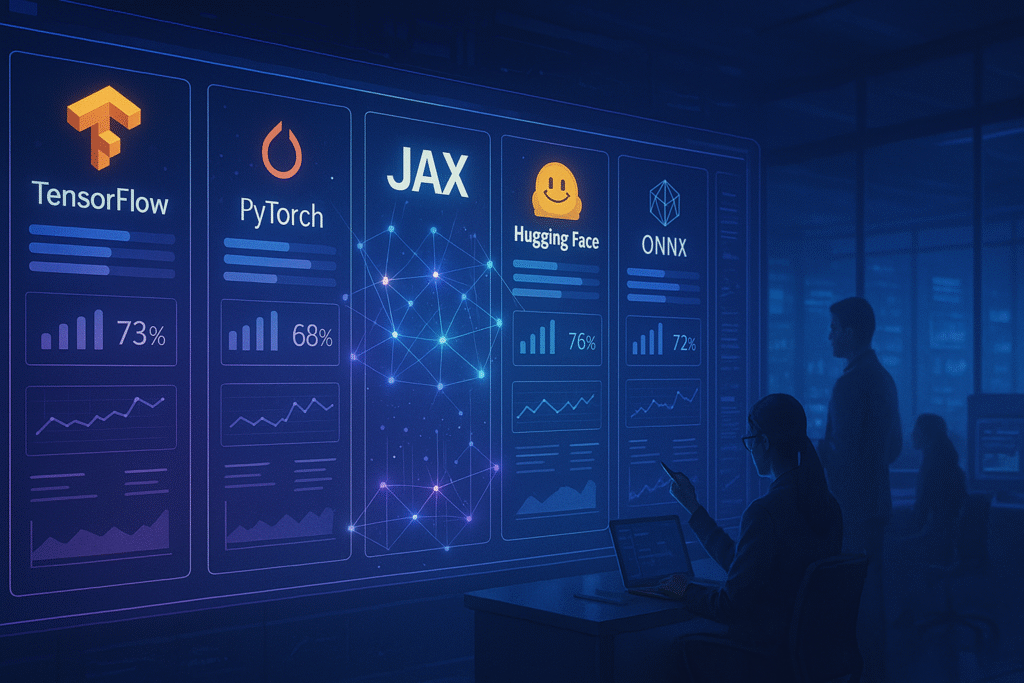
| Criteria | Frameworks That Excel | Strength |
| Research Flexibility | PyTorch, JAX, Flux | Ideal for innovation and experimentation |
| Production Readiness | TensorFlow, ONNX Runtime | Perfect for deployment and scaling |
| Edge Deployment | TensorFlow Lite, PaddlePaddle | Reliable for mobile and IoT systems |
| Enterprise Use | Deeplearning4j, MXNet | Strong integration in corporate stacks |
| Community Power | TensorFlow, PyTorch, Hugging Face | Large knowledge base and fast support |
Each framework has its story. Each one in the top 10 machine learning frameworks to use in 2025 serves a unique need. There is no single winner; there are only smart choices depending on your goal.
Stories from the Field
A Research Lab in Singapore chose JAX and PyTorch to develop next-generation protein models because flexibility was their top priority.
A Healthcare Startup in Mumbai used TensorFlow Lite to deploy diagnostic models to remote clinics without internet access.
A Trading Company in London integrated Deeplearning4j into its Java servers for real-time stock prediction.
A Chinese Tech Firm built an entire voice assistant ecosystem with PaddlePaddle, optimized for local language and devices.
Each of these teams used one or more of the top 10 machine learning frameworks to use in 2025, proving that every framework has its home.
How to Choose the Right Framework for You
If you are just entering the world of machine learning in 2025, here is a simple roadmap.
- Define Your Goal
Are you building a research prototype or a production system? - Assess Your Team’s Skills
If your team is familiar with Python, PyTorch and TensorFlow are safe bets. - Think About Deployment Early
If you want to deploy on mobile or embedded systems, TensorFlow Lite or ONNX Runtime will help. - Consider Interoperability
If you might switch frameworks later, make sure your choice exports easily to ONNX. - Follow the Community Pulse
Frameworks with active GitHub repositories and frequent updates are safer for long-term projects.
Choosing from the top 10 machine learning frameworks to use in 2025 should be guided by clarity, not curiosity.
Frequently Asked Questions
Q: Can I use more than one framework?
Yes. Many teams train models in PyTorch and deploy them with ONNX Runtime.
Q: Which framework is best for deep research?
JAX and PyTorch are preferred for innovation and flexibility.
Q: Which one is best for startups?
TensorFlow with Keras offers scalability and strong production tools.
Q: Are all ten frameworks open source?
Yes, all of them are open source, making them accessible for learners and professionals alike.
These answers come from years of observing how the top 10 machine learning frameworks to use in 2025 evolve in real projects.
Conclusion: The Future Belongs to Adaptable Minds
Frameworks are not just tools. They are the language in which innovation speaks. When you master a framework, you master a way of thinking.
From TensorFlow’s production stability to PyTorch’s artistic freedom, from JAX’s mathematical brilliance to Hugging Face’s simplicity, the top 10 machine learning frameworks to use in 2025 represent humanity’s collective effort to make machines think, learn, and create.
The real secret is not which framework you use. It is how you use it, how you experiment, and how you grow with it.
So, as you build your next model, remember this story from the Himalayan valley. The right framework can turn limited resources into limitless innovation.
That is the real power behind the top 10 machine learning frameworks to use in 2025.