

7 Best AI Bookkeeping Software for Small Businesses in 2026
Writer & Blogger
Rahul Goswami
Share
Published on
Read Time
Approx 8 min
Quick Overview
AI bookkeeping software helps businesses automate financial tasks such as transaction categorization, expense tracking, invoice management, bank reconciliation, financial reporting, and cash flow monitoring. Instead of spending hours entering data manually, businesses can use artificial intelligence to organize financial records, reduce errors, and improve accuracy.
Modern AI bookkeeping platforms go beyond traditional accounting software by automatically recognizing transactions, detecting duplicate entries, generating financial insights, and simplifying routine bookkeeping tasks. Many also integrate with bank accounts, payment gateways, payroll systems, and accounting software to create a more connected financial workflow.
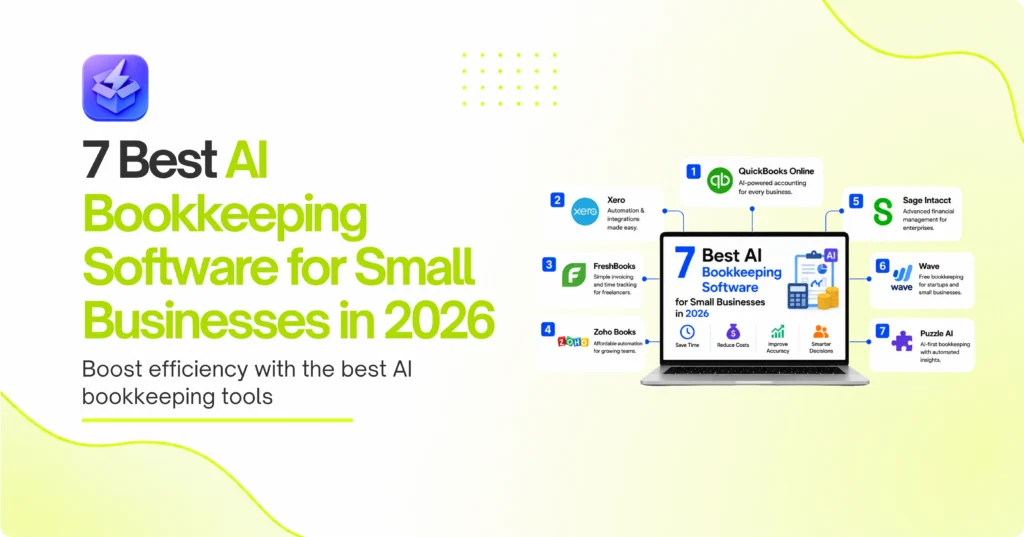
The best AI bookkeeping software depends on your business size, accounting needs, budget, and existing financial tools. QuickBooks Online is a strong all-around choice, while Xero is popular among growing businesses. FreshBooks works well for freelancers, Zoho Books offers excellent value for small businesses, Sage Intacct targets larger organizations, Wave provides a free option for startups, and Puzzle AI focuses on AI-powered bookkeeping automation.
In this guide, we compare the best AI bookkeeping software based on automation, integrations, ease of use, reporting, pricing, and overall value.
Best AI Bookkeeping Software Compared
| Software | Best For | Main Strength |
|---|---|---|
| QuickBooks Online | Overall bookkeeping | AI-powered accounting |
| Xero | Growing businesses | Automation & integrations |
| FreshBooks | Freelancers | Simple invoicing |
| Zoho Books | Small businesses | Affordable automation |
| Sage Intacct | Enterprises | Advanced financial management |
| Wave | Startups | Free bookkeeping |
| Puzzle AI | AI-first bookkeeping | Automated accounting |
1. QuickBooks Online Is the Best Overall AI Bookkeeping Software
QuickBooks Online is one of the most widely used accounting platforms for businesses of all sizes. Its AI-powered bookkeeping features help automate expense categorization, transaction matching, invoice tracking, and financial reporting.
Businesses can connect bank accounts, monitor cash flow, create invoices, process payments, and generate reports from one dashboard. AI features reduce manual bookkeeping while helping users identify unusual transactions and financial trends.
Key Features
- AI transaction categorization
- Automated bank reconciliation
- Smart financial reports
- Expense tracking
- Invoice management
- Payroll integration
- Mobile app
Why Choose QuickBooks Online?
QuickBooks Online is ideal for businesses looking for a complete bookkeeping solution with powerful automation features. Although pricing can increase as businesses grow, it remains one of the most comprehensive accounting platforms available.
2. Xero Is Great for Growing Businesses
Xero combines cloud accounting with intelligent bookkeeping automation. It simplifies bank reconciliation, invoice management, expense tracking, and financial reporting through automation.
Its extensive integration marketplace allows businesses to connect hundreds of third-party applications, making it suitable for expanding companies.
Key Features
- Smart bank reconciliation
- AI-assisted bookkeeping
- Financial dashboards
- Invoice automation
- Inventory support
- Expense management
Pros and Cons
Xero offers an intuitive interface and strong automation capabilities. It works especially well for businesses expecting future growth, although new users may need time to learn some advanced features.
3. FreshBooks Simplifies Bookkeeping for Freelancers
FreshBooks focuses on freelancers, consultants, and service-based businesses that need easy bookkeeping without unnecessary complexity.
Users can automatically track expenses, create invoices, manage payments, and monitor project profitability from one platform.
Key Features
- Smart expense tracking
- Automated invoicing
- Time tracking
- Payment reminders
- Financial reporting
Pros and Cons
FreshBooks is simple to use and ideal for small service businesses. However, larger organizations requiring advanced accounting features may need a more comprehensive platform.
4. Zoho Books Offers Excellent Value
Zoho Books combines bookkeeping automation with invoicing, inventory, banking, tax management, and financial reporting.
Its automation tools reduce repetitive bookkeeping tasks while helping businesses maintain accurate financial records.
Key Features
- Automated workflows
- Bank feeds
- Expense tracking
- Inventory management
- Tax support
- Financial reports
Pros and Cons
Zoho Books provides excellent value for small businesses, especially those already using other Zoho applications. Some advanced features may require higher subscription plans.
5. Sage Intacct Supports Enterprise Financial Management
Sage Intacct is designed for medium and large businesses that require advanced accounting, financial planning, compliance, and reporting.
Its automation features streamline complex accounting workflows while providing deeper financial insights.
Key Features
- AI financial analysis
- Multi-entity accounting
- Budgeting
- Cash flow forecasting
- Compliance reporting
Pros and Cons
Sage Intacct is powerful but may be more complex than small businesses require. It is best suited for organizations with dedicated finance teams.
6. Wave Is a Great Free Option
Wave provides free bookkeeping software for freelancers and startups. Users can automate income tracking, expense categorization, invoicing, and financial reporting without paying for core bookkeeping features.
Key Features
- Free bookkeeping
- Expense tracking
- Invoice management
- Bank connections
- Financial reports
Pros and Cons
Wave offers excellent value for startups and freelancers. Businesses requiring advanced automation or inventory management may eventually need paid software.
7. Puzzle AI Focuses on Automated Bookkeeping
Puzzle AI is a newer bookkeeping platform built around artificial intelligence. Instead of requiring manual bookkeeping, it automatically categorizes transactions, reconciles accounts, and generates financial reports using AI.
Key Features
- AI bookkeeping
- Automated reconciliation
- Financial insights
- Real-time reporting
- Smart categorization
Pros and Cons
Puzzle AI is ideal for businesses looking to minimize manual bookkeeping. As a newer platform, some businesses may find its integration ecosystem smaller than established competitors.
How to Choose the Best AI Bookkeeping Software
Before selecting software, identify your business’s accounting requirements. Freelancers often need simple invoicing and expense tracking, while larger businesses require payroll, inventory management, compliance, and advanced reporting.
Compare Automation Features
Look for software that offers:
- AI transaction categorization
- Automated reconciliation
- Invoice automation
- Expense tracking
- Financial reporting
- Cash flow insights
Consider Integrations and Growth
Choose software that integrates with your bank, payment processors, payroll systems, CRM, and other business tools. Also consider pricing as your business grows.
Final Thought
The best AI bookkeeping software depends on your business needs. QuickBooks Online remains one of the strongest overall solutions because it combines AI-powered bookkeeping with comprehensive accounting features. Xero is excellent for growing businesses, while FreshBooks works well for freelancers and service providers.
Zoho Books delivers strong value for small businesses, Sage Intacct supports enterprise financial management, Wave provides a capable free solution, and Puzzle AI focuses on next-generation AI bookkeeping automation.
Before making a decision, compare automation features, integrations, reporting capabilities, and pricing. The right AI bookkeeping software can save time, reduce manual errors, improve financial accuracy, and allow businesses to focus more on growth than administrative work.
FAQ
What is AI bookkeeping software?
AI bookkeeping software uses artificial intelligence to automate bookkeeping tasks such as transaction categorization, reconciliation, expense tracking, invoicing, and financial reporting.
Which AI bookkeeping software is best?
QuickBooks Online is one of the best overall options because it combines powerful accounting features with AI automation.
Can AI replace a bookkeeper?
AI can automate many routine bookkeeping tasks, but businesses may still need professional accountants for tax planning, audits, financial strategy, and regulatory compliance.
Is AI bookkeeping accurate?
Most AI bookkeeping platforms provide highly accurate automation when properly configured and connected to financial accounts.
Is free AI bookkeeping software available?
Yes. Wave offers free bookkeeping features, although advanced capabilities may require paid services.
Is AI bookkeeping suitable for small businesses?
Yes. AI bookkeeping software can help small businesses save time, reduce manual data entry, improve financial accuracy, and simplify accounting processes.