

7 Best Real Estate Automation Software in 2026
Writer & Blogger
Rahul Goswami
Share
Published on
Read Time
Approx 8 min
Quick Overview
Real estate automation software helps agents, brokers, property managers, and real estate businesses automate repetitive tasks such as lead management, email marketing, appointment scheduling, document generation, transaction tracking, and client communication. By reducing manual work, these platforms allow professionals to focus on closing deals and building stronger client relationships.
Modern real estate automation tools use artificial intelligence (AI), workflow automation, customer relationship management (CRM), and analytics to streamline daily operations. Many platforms also integrate with Multiple Listing Services (MLS), email providers, marketing tools, accounting software, and electronic signature solutions, creating a centralized system for managing the entire sales process.
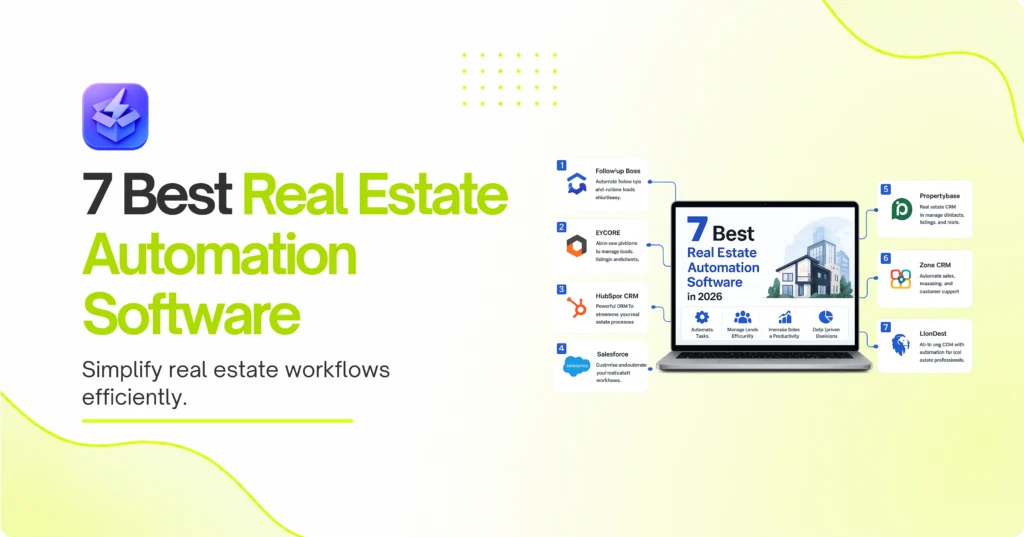
The best real estate automation software depends on your business size, budget, and workflow requirements. Follow Up Boss is an excellent CRM for lead management, kvCORE offers powerful marketing automation, HubSpot provides an all-in-one CRM platform, Salesforce delivers enterprise-grade automation, Propertybase is ideal for growing brokerages, Zoho CRM offers affordability and flexibility, and LionDesk specializes in communication automation.
In this guide, we’ll compare the best real estate automation software based on features, automation capabilities, integrations, ease of use, pricing, and overall value.
Best Real Estate Automation Software Compared
| Software | Best For | Main Strength |
|---|---|---|
| Follow Up Boss | Real estate agents | Lead management automation |
| kvCORE | Brokerages | Marketing automation |
| HubSpot CRM | Growing businesses | CRM & workflow automation |
| Salesforce | Enterprises | Advanced automation |
| Propertybase | Brokerages | End-to-end real estate CRM |
| Zoho CRM | Small businesses | Affordable automation |
| LionDesk | Communication | Automated follow-ups |
1. Follow Up Boss Is the Best Overall Real Estate Automation Software
Follow Up Boss is one of the most popular CRM platforms built specifically for real estate professionals. It automatically captures leads from websites, advertising platforms, and property portals while helping agents manage communications from one dashboard.
Its automation tools reduce response times, schedule follow-ups, assign leads, and track the sales pipeline, ensuring that no opportunity is overlooked.
Key Features
- Lead capture automation
- Smart follow-up reminders
- Contact management
- Pipeline tracking
- Email integration
- Team collaboration
- Reporting dashboard
Pros and Cons
Follow Up Boss is easy to use and highly effective for lead management. While it focuses primarily on CRM functionality, businesses needing advanced marketing automation may benefit from pairing it with additional tools.
2. kvCORE Excels at Marketing Automation
kvCORE combines CRM, lead generation, marketing automation, and website management into a single platform. It helps real estate professionals nurture leads through automated email campaigns, text messaging, and personalized property recommendations.
The platform also includes IDX websites, helping agents attract new prospects while automating engagement.
Key Features
- Marketing automation
- Lead nurturing
- IDX websites
- Email campaigns
- SMS automation
- AI-powered recommendations
- CRM integration
Pros and Cons
kvCORE is ideal for brokerages and teams looking for comprehensive marketing automation. Smaller agencies with limited budgets may find its pricing higher than simpler CRM solutions.
3. HubSpot CRM Offers Flexible Workflow Automation
HubSpot CRM provides automation tools that help real estate businesses organize contacts, automate follow-up emails, manage deals, and monitor sales performance.
Its drag-and-drop workflow builder allows businesses to automate repetitive tasks without requiring technical expertise.
Key Features
- Workflow automation
- Email marketing
- Contact management
- Deal tracking
- Live chat
- Reporting
- Third-party integrations
Pros and Cons
HubSpot is an excellent option for businesses wanting a flexible CRM beyond real estate. Some advanced automation features are only available on premium plans.
4. Salesforce Delivers Enterprise-Level Automation
Salesforce is a highly customizable CRM platform used by large real estate organizations. It automates lead routing, opportunity management, document workflows, reporting, and customer communications.
Its AI-powered Einstein platform provides predictive insights that help sales teams prioritize leads and improve conversion rates.
Key Features
- AI-powered lead scoring
- Workflow automation
- Advanced analytics
- Customer management
- Custom dashboards
- Mobile access
- Enterprise integrations
Pros and Cons
Salesforce offers unmatched flexibility and scalability. However, implementation often requires additional configuration and training.
5. Propertybase Is Designed for Growing Brokerages
Propertybase combines CRM, transaction management, marketing, and back-office automation into a single platform built specifically for the real estate industry.
It enables brokerages to manage listings, clients, transactions, and marketing campaigns more efficiently.
Key Features
- Real estate CRM
- Transaction management
- Marketing automation
- Property listings
- Lead management
- Reporting
- Mobile app
Pros and Cons
Propertybase is an excellent fit for expanding brokerages. Smaller independent agents may find simpler CRM solutions sufficient.
6. Zoho CRM Provides Affordable Automation
Zoho CRM offers customizable automation for lead management, sales workflows, customer communication, and reporting. Its affordability makes it a popular option for small real estate agencies and independent agents.
The platform integrates with many third-party business applications, improving operational efficiency.
Key Features
- Workflow automation
- Lead management
- Email automation
- Sales pipeline
- Analytics
- Mobile CRM
- AI assistant
Pros and Cons
Zoho CRM delivers strong value for small businesses. Some advanced automation capabilities require higher subscription tiers.
7. LionDesk Simplifies Client Communication
LionDesk focuses on automating communication between real estate professionals and clients. It supports email campaigns, SMS marketing, video messaging, and automated follow-up sequences.
These tools help agents maintain consistent communication throughout the buying or selling process.
Key Features
- Email automation
- SMS campaigns
- Video messaging
- Contact management
- Task reminders
- Pipeline tracking
- CRM integration
Pros and Cons
LionDesk is ideal for agents prioritizing communication and lead nurturing. Organizations needing broader business automation may require additional software.
How to Choose the Best Real Estate Automation Software
The best real estate automation software depends on your business goals and workflow. Independent agents often need simple lead management and communication tools, while brokerages may require marketing automation, transaction management, and advanced reporting.
Compare Core Features
Look for software that includes:
- Lead capture
- CRM
- Workflow automation
- Email marketing
- SMS automation
- Appointment scheduling
- Transaction management
- Reporting and analytics
- Mobile access
Consider Integrations and Scalability
Choose software that integrates with MLS platforms, email providers, e-signature tools, accounting software, and marketing applications. Scalability is equally important if you expect your real estate business to grow over time.
Final Thought
Real estate automation software helps professionals save time, improve client communication, and increase sales efficiency. Follow Up Boss remains one of the best overall platforms for lead management, while kvCORE excels at marketing automation.
HubSpot CRM provides flexible workflows, Salesforce offers enterprise-grade automation, Propertybase supports growing brokerages, Zoho CRM delivers excellent value, and LionDesk strengthens client communication through automated follow-ups.
Before selecting a platform, compare features, integrations, pricing, and ease of use. The right real estate automation software can streamline daily operations, improve lead conversion, and help your business close more deals with less manual effort.
FAQ
What is real estate automation software?
Real estate automation software helps agents and brokerages automate tasks such as lead management, follow-ups, marketing, transaction tracking, and client communication.
Which real estate automation software is the best?
Follow Up Boss is one of the best overall options due to its powerful lead management and CRM automation features.
How does automation help real estate agents?
Automation reduces manual work by handling repetitive tasks like email campaigns, appointment reminders, lead nurturing, and workflow management, allowing agents to focus on clients and sales.
Can real estate automation software improve lead conversion?
Follow Up Boss is one of the best overall options due to its powerful lead management and CRM automation features.
Is real estate automation software suitable for small agencies?
Yes. Many platforms, such as Zoho CRM and HubSpot CRM, offer affordable plans with automation features that are ideal for independent agents and small real estate businesses.
What features should I look for in real estate automation software?
Look for lead management, CRM functionality, workflow automation, email and SMS marketing, transaction tracking, reporting, mobile access, and integrations with MLS, e-signature, and accounting tools.