
topsoftwareoffers.com

Uncategorized

Uncategorized

Lightweight Transformer Inference on Raspberry Pi 4

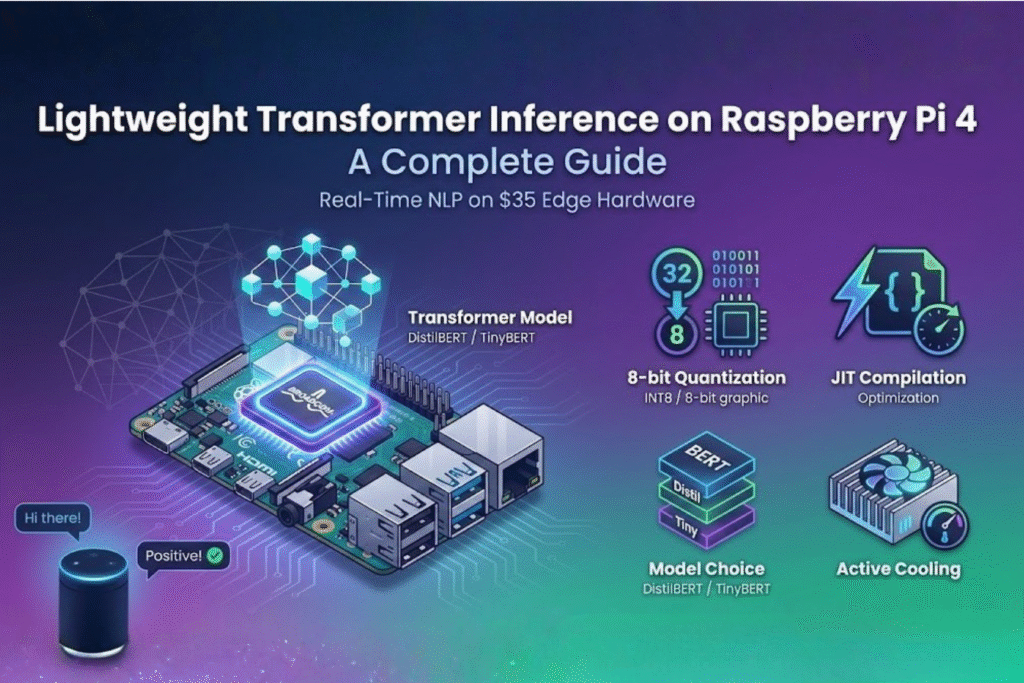
The evolution of edge computing has brought sophisticated AI capabilities to affordable hardware. Among the most exciting developments is lightweight transformer inference on Raspberry Pi 4, which enables natural language processing directly on a $35-75 device. This guide explores how to achieve real-time performance with transformer models on constrained hardware. Understanding the Hardware Challenge The Raspberry Pi 4, available in 2GB, 4GB, and 8GB RAM variants, provides ARM Cortex-A72 cores capable of handling optimized neural networks. However, transformer inference on Raspberry Pi 4 presents unique challenges. The ARM-based architecture with four cores running at 1.5 GHz excels at power efficiency rather than raw computational throughput. For lightweight transformer inference on the Raspberry Pi 4 tasks, memory bandwidth becomes the primary bottleneck. The LPDDR4 RAM operates at lower speeds than desktop counterparts, making memory-intensive operations like attention mechanisms particularly challenging. This is why optimization techniques are essential for successful transformer inference on Raspberry Pi 4 implementations. The lack of dedicated neural processing units means all computation happens on the CPU. However, ARM’s NEON SIMD instructions provide vectorization capabilities that frameworks can exploit to accelerate lightweight transformer inference on Raspberry Pi 4 operations. Essential Setup for Success Setting up your system correctly makes a dramatic difference in transformer inference on the Raspberry Pi 4 performance. First, install a 64-bit operating system. The aarch64 architecture provides access to optimized libraries that can double performance compared to 32-bit systems for lightweight transformer inference on Raspberry Pi 4 applications. Thermal management cannot be overlooked when running transformer inference on the Raspberry Pi 4. Sustained inference workloads generate significant heat. Without adequate cooling, the Pi 4 will throttle performance, reducing your model’s speed by 20-40%. Heat sinks and active cooling fans are recommended for any serious lightweight transformer inference on Raspberry Pi 4 deployment. Configure your boot settings to allocate appropriate GPU memory if you’re combining vision tasks with language processing. While the Pi’s GPU won’t accelerate transformer computations directly, proper memory allocation ensures system stability during transformer inference on Raspberry Pi 4 operations. Power supply quality matters more than many developers realize. Insufficient power causes voltage drops under load, leading to system instability during intensive lightweight transformer inference on the Raspberry Pi 4 operations. Use a quality 5V 3A USB-C power supply for reliable performance. Framework Selection Choosing the right deep learning framework significantly impacts lightweight transformer inference on Raspberry Pi 4 performance. PyTorch provides excellent ARM support with the qnnpack backend, specifically designed for quantized neural networks on mobile and embedded devices. The framework can be installed via pip and works seamlessly on 64-bit Raspberry Pi OS. TensorFlow Lite offers another excellent option with comprehensive ARM optimizations and smaller deployment footprints ideal for transformer inference on Raspberry Pi 4 scenarios. Its delegate system allows hardware-specific accelerations that improve performance. ONNX Runtime has emerged as a compelling choice for transformer inference on the Raspberry Pi 4 due to its aggressive graph optimizations and broad model format support. It can automatically apply operator fusion, constant folding, and layout transformations that dramatically improve performance for lightweight transformer inference on the Raspberry Pi 4. Model Architecture Selection Not all transformer architectures are equally suited for transformer inference on Raspberry Pi 4. Traditional BERT models with 110M parameters prove too large for comfortable real-time inference. This is where distilled variants become essential for lightweight transformer inference on Raspberry Pi 4 applications. DistilBERT reduces the original BERT’s size by 40% while retaining 97% of its language understanding capabilities. This makes it an excellent starting point for transformer inference on the Raspberry Pi 4. With 66M parameters, it strikes a balance between capability and efficiency, making it ideal for sentiment analysis, text classification, and question answering tasks. TinyBERT pushes compression even further, achieving 7.5x smaller size through aggressive knowledge distillation. For resource-constrained lightweight transformer inference on Raspberry Pi 4 scenarios, TinyBERT delivers impressive results with only 14.5M parameters while maintaining strong performance on downstream tasks. MobileBERT, designed specifically for mobile and edge devices, employs bottleneck structures and inverted-bottleneck attention mechanisms. Its architecture is optimized for the exact scenarios encountered in transformer inference on Raspberry Pi 4 deployments, providing excellent latency-accuracy trade-offs. ALBERT (A Lite BERT) uses parameter sharing across layers to reduce model size significantly. This makes it another strong candidate for lightweight transformer inference on the Raspberry Pi 4, especially when you need larger model capacity without proportional memory increases. Quantization: The Performance Multiplier Quantization is the single most impactful optimization for lightweight transformer inference on the Raspberry Pi 4. Converting 32-bit floating-point weights to 8-bit integers reduces model size by 4x and dramatically accelerates computation through INT8 arithmetic units available in ARM processors. For transformer inference on Raspberry Pi 4, dynamic quantization offers the best trade-off. Weights are stored as INT8, while activations are computed in floating-point and dynamically quantized. This approach maintains accuracy while achieving 2-4x speedups for lightweight transformer inference on the Raspberry Pi 4. Post-training quantization requires no retraining, making it ideal for quick transformer inference on Raspberry Pi 4 deployments. However, quantization-aware training yields even better results if you’re training custom models specifically for lightweight transformer inference on the Raspberry Pi 4 applications. The qnnpack backend, specifically designed for ARM processors, enables these quantization benefits. Activating qnnpack is essential for achieving optimal performance in transformer inference on the Raspberry Pi 4 scenarios. JIT Compilation Benefits Just-In-Time compilation transforms Python code into optimized intermediate representations that execute faster. For transformer inference on the Raspberry Pi 4, JIT can provide 1.5-2x speedups by eliminating Python interpreter overhead and enabling operation fusion. Script mode in PyTorch allows the entire model to be compiled ahead of time, which can increase lightweight transformer inference on Raspberry Pi 4 throughput from 20 frames per second to 30 fps by fusing operations and optimizing execution graphs. When implementing transformer inference on Raspberry Pi 4 with JIT, test thoroughly. Some dynamic Python behaviors don’t translate well to scripted code, potentially causing runtime errors in your lightweight transformer inference on the Raspberry Pi

Uncategorized

Top 10 Trending Industrial IoT Projects for 2025 with Source Code: A Complete Guide to Smart Manufacturing

The industrial landscape is undergoing a massive transformation, and at the heart of this revolution lies the Top 10 Trending Industrial IoT Projects for 2025 with Source Code. These projects aren’t just theoretical concepts; they’re practical, implementable solutions that are reshaping how factories, warehouses, and manufacturing facilities operate in real time. Understanding the Industrial IoT Revolution Before diving into the Top 10 Trending Industrial IoT Projects for 2025 with Source Code, it’s essential to understand why Industrial IoT has become the cornerstone of modern manufacturing. Unlike consumer IoT devices that focus on convenience, Industrial IoT (IIoT) systems are designed for durability, reliability, and precision. They connect machines, sensors, cloud platforms, and analytics engines to create intelligent ecosystems that optimize efficiency, enhance safety, and enable data-driven decision making. The Top 10 Trending Industrial IoT Projects for 2025 with Source Code represent the cutting edge of this technology, offering ready to implement solutions that address real world industrial challenges. From predictive maintenance to energy optimization, these projects demonstrate how connected intelligence transforms operational challenges into competitive advantages. Why These Projects Matter in 2025 As we navigate through 2025, the demand for smart manufacturing solutions has reached unprecedented levels. The Top 10 Trending Industrial IoT Projects for 2025 with Source Code have been carefully curated to address the most pressing needs of modern industries. These projects leverage advanced technologies including edge AI, machine learning, cloud computing, and real time analytics to deliver measurable results. What makes the Top 10 Trending Industrial IoT Projects for 2025 with Source Code particularly valuable is their accessibility. Each project comes with complete source code, detailed documentation, and step by step implementation guides, making it possible for engineers and developers at all skill levels to deploy these solutions in their facilities. Project Number 1: Real Time Structural Health Monitoring System The first entry in our Top 10 Trending Industrial IoT Projects for 2025 with Source Code tackles one of the most critical aspects of industrial safety: structural integrity monitoring. This sophisticated system employs precision sensors, including strain gauges and vibration detectors, to continuously assess the health of critical infrastructure such as bridges, factory complexes, and industrial sheds. The beauty of this project lies in its comprehensive approach. Using ESP32 microcontrollers as edge devices, the system captures real time data from strategically placed sensors. These sensors measure crack propagation, abnormal vibrations, and dynamic load stress with remarkable accuracy. The HX711 amplifier ensures that even the slightest strain measurements are captured with precision. Data flows seamlessly from the edge devices to AWS IoT Core using the lightweight MQTT protocol. Once in the cloud, AWS services process the information, compare it against predefined thresholds, and trigger immediate SMS or email alerts when anomalies are detected. Engineers can monitor everything through an intuitive Grafana dashboard that displays real time graphs, historical trends, and status indicators. This project demonstrates why it’s included in the Top 10 Trending Industrial IoT Projects for 2025 with Source Code because it transforms reactive maintenance into proactive, data driven strategy, potentially saving millions in repair costs and preventing catastrophic failures. The Technology Stack Behind These Projects When exploring the Top 10 Trending Industrial IoT Projects for 2025 with Source Code, you’ll notice common technological threads that run through each implementation. These projects leverage powerful microcontrollers like the ESP32, which offers Wi-Fi connectivity and robust processing capabilities at an affordable price point. Cloud platforms, particularly AWS IoT Core, serve as the backbone for data ingestion, processing, and storage. The MQTT protocol has emerged as the standard for IoT communication due to its lightweight nature and reliability. Visualization tools like Grafana provide the critical human interface, transforming raw data streams into actionable insights. Project Number 2: Industrial Fire Detection with Edge AI The second project in our Top 10 Trending Industrial IoT Projects for 2025 with Source Code addresses another critical safety concern: fire detection. Unlike traditional smoke detectors, this system employs edge AI to identify fires through visual recognition, detecting flames and smoke patterns before conventional sensors would trigger. By deploying cameras with onboard processing capabilities, this system analyzes video feeds in real time without sending massive data streams to the cloud. The edge AI algorithms can distinguish between actual fires and false positives like steam or dust, dramatically reducing false alarms while ensuring rapid response to genuine emergencies. Project Number 3: Predictive Maintenance for CNC Machines Predictive maintenance represents one of the most valuable applications in the Top 10 Trending Industrial IoT Projects for 2025 with Source Code. This project monitors CNC machines in real time, analyzing vibration patterns, temperature fluctuations, and acoustic signatures to predict component failures before they occur. By implementing machine learning algorithms at the edge, the system learns normal operational patterns and immediately flags anomalies. This proactive approach reduces unplanned downtime by up to 70% and extends machine lifespan significantly. The source code includes trained models and data preprocessing pipelines that can be adapted to various machine types and operating conditions. Project Number 4: Industrial Tank Level Monitoring System Tank level monitoring might seem straightforward, but when you examine this entry in the Top 10 Trending Industrial IoT Projects for 2025 with Source Code, you’ll discover sophisticated features that go far beyond simple measurement. This system tracks liquid levels across multiple tanks simultaneously, calculates consumption rates, predicts refill schedules, and optimizes inventory management. Using ultrasonic or pressure sensors connected to IoT enabled microcontrollers, the system provides real time updates to cloud dashboards. Supply chain teams receive automated notifications when tanks approach critical levels, ensuring just in time refilling and eliminating both stockouts and overfilling incidents. The integration capabilities of this project allow it to connect with enterprise resource planning systems, automatically generating purchase orders when inventory falls below predetermined thresholds. This seamless automation reduces manual oversight requirements and minimizes human error in inventory management. Project Number 5: Conveyor Belt Health Monitoring with Machine Learning Conveyor systems are the arteries of modern manufacturing facilities, and their failure can halt entire production lines. This project

Machine Learning Frameworks
Uncategorized

Top 10 Machine Learning Frameworks to Use in 2025

Introduction: The Turning Point of Machine Learning In the winter of 2024, I visited a small artificial intelligence research lab hidden inside a quiet technology park in Bangalore. The team was working on a weather forecasting project for a remote Himalayan valley. They had limited computing resources and a very small budget. What they did have was ambition. During one meeting, the lead engineer looked around the room and said, “If we choose the wrong framework today, we will spend the next year fixing what we could have avoided.” That sentence stayed with me. That experience taught me that the right machine learning framework can make or break a project. As we step into 2025, the landscape of artificial intelligence is evolving rapidly. Frameworks are not just tools anymore; they are ecosystems that define the speed, quality, and scalability of innovation. So let us explore the Top 10 Machine Learning Frameworks to Use in 2025, understand their power, their purpose, and the kind of projects they are shaping across the world. Why Frameworks Matter in 2025 Before we dive into the actual list of the top 10 machine learning frameworks to use in 2025, it is important to understand why this choice is so significant. A machine learning framework is the foundation upon which models are built, trained, tested, and deployed. Choosing the right one determines how fast your model learns, how easily you can experiment, and how smoothly you can take your model from research to real-world application. Let us understand the pillars that make these frameworks crucial in 2025. When we talk about the top 10 machine learning frameworks to use in 2025, these are the standards they must meet. Top 10 Machine Learning Frameworks 1. TensorFlow with Keras TensorFlow remains one of the strongest contenders in any list of the top 10 machine learning frameworks to use in 2025. It is backed by Google and trusted by industries across the world. During the Himalayan valley project, one of the biggest challenges was deploying models to mobile devices with weak connectivity. TensorFlow Lite allowed the team to compress and optimize models that ran perfectly on edge sensors. That moment made everyone realize why TensorFlow remains a giant even in 2025. Why it matters in 2025: TensorFlow’s maturity ensures it remains one of the most reliable machine learning frameworks in 2025 for both research and production. 2. PyTorch If TensorFlow is the corporate workhorse, PyTorch is the artist. It is flexible, expressive, and intuitive. It is loved by researchers and dominates academic papers and experimental projects. A team I once mentored built an audio recognition model in PyTorch. They loved how easy it was to experiment, debug, and visualize results. Within weeks they had something ready to demo. That level of creativity is what makes PyTorch shine. Why it dominates the 2025 landscape: PyTorch is not just part of the top 10 machine learning frameworks to use in 2025; for many innovators, it is number one. 3. JAX JAX is the rising star that combines the simplicity of NumPy with the power of automatic differentiation and just-in-time compilation. It is one of the most promising frameworks for high-performance computing and research. When I worked with a physics simulation team, we needed gradients of a complex numerical process. Only JAX made it elegant and efficient. We wrote the code once and ran it across GPUs effortlessly. Why JAX deserves a place in the 2025 list: JAX stands as one of the most innovative machine learning frameworks to use in 2025, built for people who want precision, speed, and control. 4. Hugging Face Transformers In 2025, language models and transformers rule artificial intelligence. The Hugging Face Transformers library has become a core ecosystem, not just a toolkit. It provides ready-made models for natural language processing, image recognition, audio understanding, and even generative AI. What makes it special is accessibility. A small startup can fine-tune a billion-parameter model in hours using Hugging Face. During a personal project on environmental text summarization, we used their trainer API and achieved incredible results without any complex setup. Why it is one of the top frameworks of 2025: Hugging Face is more than a library. It is a movement that defines the machine learning frameworks of 2025. 5. TensorFlow Lite and TensorFlow Extended TensorFlow Lite and TensorFlow Extended deserve a separate mention because they have become essential for deployment and monitoring. TensorFlow Lite brings machine learning to phones, IoT devices, and edge systems. TensorFlow Extended manages the entire production lifecycle from data validation to model serving. I saw this combination power an agricultural monitoring system that detected crop diseases in real time using small devices in Indian fields. It was affordable and reliable, proving why this framework remains vital in 2025. Why they belong to the top 10 list: The top 10 machine learning frameworks to use in 2025 must include TensorFlow Lite and TFX because they bring real products to life. 6. Apache MXNet MXNet is known for its scalability and multi-language support. Though quieter in recent years, it remains a dependable option, especially for enterprise systems that integrate with Java or Scala environments. In 2025, many businesses still use MXNet because of its distributed training capabilities. A fintech company I worked with trained massive fraud detection models across multiple GPUs using MXNet with remarkable stability. Why it stands out: MXNet remains one of the top 10 machine learning frameworks in 2025 for organizations that prioritize reliability over hype. 7. Deeplearning4j For companies whose entire architecture runs on Java, Deeplearning4j is a gift. It brings deep learning to the JVM world without needing Python bridges. I once collaborated with a banking client who had strict compliance rules that required Java for everything. We implemented Deeplearning4j and integrated neural models directly into their trading system. Why it continues to stay relevant in 2025: Deeplearning4j may not be trendy, but in the top 10 machine learning frameworks of 2025, it remains the professional’s choice for enterprise

Scroll to Top