

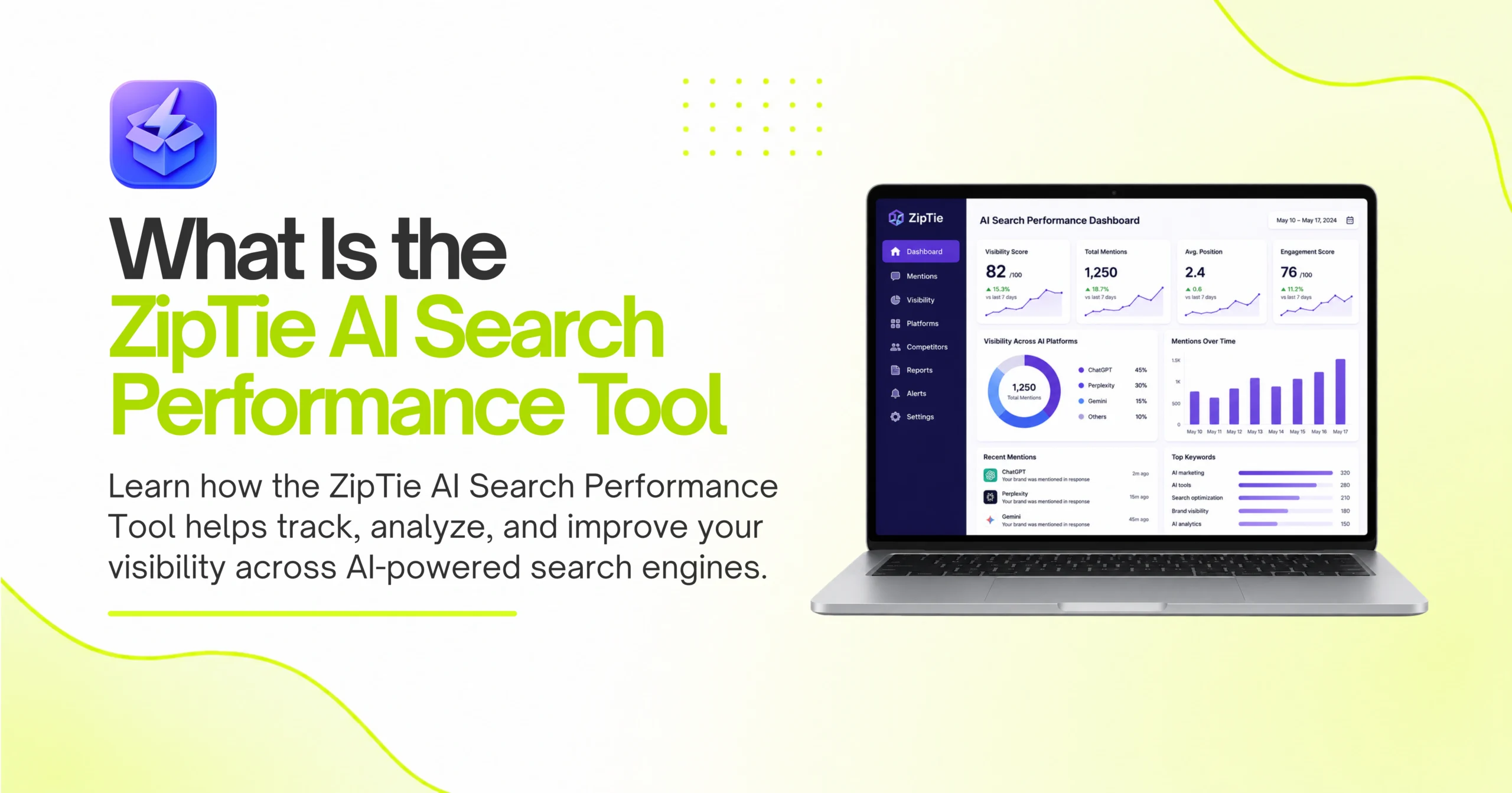
In Short
The ZipTie AI search performance tool is a specialized tracking platform that monitors how often your brand appears in AI-generated search responses. It analyzes platforms like Google AI Overviews and Perplexity to measure brand visibility, identify citation gaps, and track generative search share of voice over time.
Key Takeaways
- Track your brand visibility directly inside Google AI Overviews and Perplexity responses.
- Measure generative search share of voice instead of traditional blue link rankings.
- Identify exactly which competitors steal your citations in AI-generated answers.
- Group software deals by category to build internal linking silos for AI context.
Marcus sat at his desk staring at a 30% drop in organic traffic for his SaaS company. His traditional rank trackers showed his pages still sitting at position one. Consequently, he realized Google’s new AI Overviews were answering user queries directly, pushing his blue links down the page. He needed a way to see if his brand was actually appearing inside those generated answers. When traffic drops despite stable rankings, many marketers ask what the ziptie AI search performance tool is and how it can help. This platform solves the exact problem Marcus faced.

Understanding How ZipTie Changes Search Tracking
ZipTie shifts your focus from tracking standard web links to measuring actual presence inside AI-generated responses. Traditional SEO tools measure where a page ranks on a list. Instead, this platform calculates how frequently AI engines select your content as a cited source for user queries.
Shifting from Blue Links to Generative Answers
Historically, SEO teams obsessed over the top three search positions. They poured resources into backlink building and keyword stuffing to secure those spots. As a result, they ignored everything else happening on the search engine results page. Today, Google AI Overviews and Perplexity dominate the top of the screen. These massive text blocks push traditional results far down the page. Therefore, holding position one matters less if an AI box pushes that result below the fold. You must adapt your tracking. ZipTie shows you exactly what text the AI generates for your target keywords. It reveals the exact pixels your brand occupies.

The Mechanics of AI Search Visibility
AI engines do not rank pages. Instead, they synthesize information from multiple sources. Consequently, your goal is to become a trusted citation. ZipTie scans these generated answers. Then, it highlights which domains the AI trusts most for specific topics. Because of this, you can see if your content feeds the AI or if a competitor beats you. When people ask what the ziptie AI search performance toolis, they usually want to know how it extracts this specific citation data. The platform runs queries at scale, captures the AI output, and parses the links embedded in the text.
How Does the ZipTie AI Search Performance Tool Work?
The platform runs thousands of search queries through AI engines and records the generated text and citations. It then cross-references those citations against your domain. Consequently, you get a clear dashboard showing your exact share of voice within AI answers across different regions and topics.
Tracking Brand Mentions Across AI Engines
You upload a list of target keywords just like a standard rank tracker. You might upload 5,000 terms related to SaaS deals. Subsequently, ZipTie queries Google SGE or other AI search platforms from specific geographic locations. The tool captures the entire AI-generated response as a screenshot and extracts the raw text. Next, it checks if your website appears as a clickable citation within that text. This process reveals your true visibility. For example, you might rank poorly in traditional search but dominate the AI citations for a specific niche. This happens often when smaller sites produce highly structured, factual content that AI models prefer.
Identifying Content Gaps in AI Responses
Competitor analysis looks different in the AI era. Therefore, you need to see who the AI prefers. ZipTie lists the domains that frequently appear alongside your target queries. If a competitor shows up in 80% of AI answers and you appear in zero, you have a content gap. Specifically, the AI finds their content more authoritative or easier to parse. You can then analyze their pages to understand why the AI prefers them. Often, highly structured content using modular blocks wins these citations.
Structuring Content for AI Search Engines
To win AI citations, you must structure your content logically and group related topics together. AI models rely on clear relationships between entities to generate accurate answers. Because of this, organizing your site into tight topic clusters drastically improves your chances of being cited by generative search engines.
Implement Topic Clusters for Better Context
AI engines need context to trust your content. They do not read pages like humans; they map relationships between entities. Therefore, you should group software deals by category. For example, create specific silos for “AI Productivity” or “SaaS for Business.” This creates strong internal linking silos. As a result, the AI model easily understands your site’s hierarchy and expertise. When you link related pages together, you pass authority between them. This structured approach makes it easier for AI crawlers to extract your data and use it in their answers. If you sell project management software, link all your feature comparisons together. Learn more about building topic silos to improve your site structure.
Optimizing for Citations Over Clicks
Generative search often satisfies the user’s intent immediately. Consequently, users click fewer links. You must optimize for brand awareness and direct citations. ZipTie helps you measure this shift. By tracking how often your brand name appears in the AI text itself, you gauge your true reach. Even if a user never clicks your link, seeing your brand recommended by an AI builds massive trust. Ultimately, this leads to direct searches for your brand later. You trade immediate clicks for long-term brand authority.
Why Do You Need Dedicated AI Tracking?
Standard SEO platforms cannot parse dynamic, AI-generated text blocks effectively. They rely on static HTML scraping. In contrast, dedicated AI tracking tools render the actual AI experience, capture the generated text, and isolate the specific citations. This gives you accurate data on zero-click search visibility.
Traditional Rank Trackers Fall Short
Most SEO software still focuses on the ten blue links. However, those links receive less traffic every month. If you only look at standard rankings, you miss the full picture. For instance, a traditional tool might report you at position two. Yet, it fails to mention that a massive AI overview pushes your link out of view. This blind spot ruins traffic projections. Many SEO professionals wonder what the ziptie AI search performance tool is going to replace. It replaces the outdated assumption that blue links equal traffic. You need data that reflects reality.
Protecting Your Traffic from Zero-Click Searches
Zero-click searches happen when the search engine answers the query directly. Consequently, the user leaves without visiting any website. AI overviews accelerate this trend. Therefore, you must track which of your keywords trigger these AI answers. ZipTie identifies queries that generate large AI blocks. As a result, you can pivot your strategy. Instead of targeting keywords with zero-click potential, you can focus on complex queries that require deep research. You force the user to click through to your site for the full answer.
Comparing ZipTie Against Standard SEO Software
ZipTie tracks generative share of voice, while standard tools track static URL positions. Standard software relies on traditional web crawling. Conversely, ZipTie acts like a user interacting with an AI model. This fundamental difference allows it to measure brand presence inside dynamic, customized AI responses.
GEO-specific Comparison Tables
Location changes AI responses drastically. Therefore, you need tools that track local variations. AI engines frequently use comparison tables to generate response citations. Creating GEO-specific comparison tables on your site helps you win these local citations.
| Feature | Standard SEO Tools | ZipTie AI Tracking |
|---|---|---|
| Primary Metric | URL Position (1-100) | Generative Share of Voice |
| Data Source | Static HTML SERPs | Dynamic AI Responses |
| Citation Tracking | No | Yes |
| Content Gap Focus | Keyword Overlap | AI Source Preference |
As the table shows, the metrics differ entirely. Consequently, you need both types of data to understand your total search visibility.
Measuring the Impact of AI Visibility
Traffic drops confuse many site owners. However, cross-referencing standard rankings with AI visibility data clears up the mystery. If your standard rank holds steady but traffic falls, check ZipTie. You will likely see an AI overview stealing the clicks. Because of this, you can explain traffic anomalies to stakeholders with hard data. You can show them exactly what the user sees. This stops executives from panicking over standard rank fluctuations.
What Features Make ZipTie Stand Out?
The platform offers unique metrics like Generative AI Share of Voice and specific citation gap analysis. It also tracks the exact pixel height of AI answers. As a result, you know exactly how much screen real estate the AI steals from your traditional organic rankings.
Generative AI Share of Voice
Share of voice usually measures how many clicks you get compared to competitors. ZipTie redefines this for the AI era. Specifically, it calculates how often you appear in AI answers across your entire keyword set. If you track 1,000 keywords, the tool shows exactly how many trigger an AI response. Then, it shows your percentage of citations within those responses. To fully understand what the ziptie AI search performance toolis, you must grasp this metric. It is the new baseline for search success.
Competitor Gap Analysis in SGE
Your traditional organic competitors might not be your AI competitors. Often, high-authority sites like GFG rank for new tech keywords almost instantly because of their massive topical authority. Their move into broad tech-industry compliance and news shows a pivot toward dominating informational queries. Their highly structured content using modular blocks makes them a preferred source for AI engine citations. Therefore, ZipTie helps you identify these specific AI competitors. You might find a small forum outranking you in AI citations because they provide direct, user-generated answers. Once you know who the AI prefers, you can study their content structure. You can then adapt your own pages to match the formats AI models favor. Read more about ZipTie’s tracking capabilities to master this process.
Building a Strategy Around AI Search Data
Data means nothing without a clear execution plan. Once you gather citation metrics, you must update your existing content to answer AI-driven queries directly. Specifically, you need to rewrite introductions, add structured data, and format your pages to feed the AI models exactly what they want.
Rewriting Content for AI Extraction
AI models look for concise, factual answers. Therefore, long, rambling introductions hurt your chances of being cited. You must adopt an answer-first writing style. Start your paragraphs with direct statements. Subsequently, back those statements up with data and examples. This structure helps the AI parse your text easily. When a user asks what the ziptie AI search performance toolis, the AI looks for a clear definition. If your page hides the definition at the bottom, the AI will ignore you. Instead, put the most important information at the top of the page.
Utilizing Structured Data and Lists
AI engines love lists. They frequently pull bullet points and numbered lists directly into their generated answers. Because of this, you should format your content logically. Break complex topics into digestible steps. Use clear H2 and H3 headings to guide the crawler. Consequently, you increase your chances of becoming a featured citation. Add schema markup to your pages to provide even more context. This technical SEO step remains crucial, even in the age of generative AI.
How Do You Track ROI with AI Search Tools?
Proving ROI from AI citations requires tracking brand search volume and referral traffic. While direct clicks from AI answers might be lower than traditional search, being cited builds immense brand authority. Consequently, you measure success by monitoring increases in direct traffic and brand-specific queries over time.
The Shift Toward Brand Authority
Generative search changes how users interact with brands. If an AI consistently recommends your software, users trust you more. Therefore, your brand authority grows. You might not see an immediate click from the AI overview. However, that user will likely search for your brand name later. Because of this, you must track branded search volume alongside your ZipTie data. If your AI share of voice increases, your branded searches should follow. This correlation proves the value of AI optimization.
Adapting to Future Search Trends
The search industry changes rapidly. Google and Perplexity constantly update their models. As a result, you need tools that adapt quickly. ZipTie updates its tracking parameters to match these shifts. For example, if Google changes how it displays citations, the platform adjusts its metrics. You cannot rely on static tools in a dynamic environment. Ultimately, investing in AI search performance tracking protects your digital marketing strategy. You stay ahead of the curve while competitors scramble to understand why their traffic disappeared.
Setting Up Your First ZipTie Tracking Campaign
Launching a tracking campaign requires selecting high-intent keywords and defining your target regions. You start by importing your most valuable search terms into the dashboard. Then, you configure the tool to track specific AI engines like Google SGE. This setup provides immediate baseline data for your brand visibility.
Selecting the Right Keywords
Do not track every keyword on your site. Instead, focus on terms that drive actual revenue. Generative AI struggles with highly transactional queries but excels at informational and comparison searches. Therefore, you should track keywords like “best CRM for small business” rather than just “buy CRM.” ZipTie will show you exactly how the AI answers these comparison questions. Consequently, you can see if the AI recommends your product or your competitor’s product. If you track the wrong keywords, you waste crawl budget and gather useless data.
Analyzing the Initial Baseline Report
Once the tool finishes its first crawl, you receive a baseline report. This report is often a wake-up call for marketing teams. You might discover that your site appears in zero AI overviews despite strong traditional traffic. Because of this, you must treat the baseline report as a starting point, not a failure. Look at the domains that currently win the citations. Analyze their page structure, their use of schema, and their writing style. Then, build a roadmap to systematically update your content to compete for those specific AI placements.
Troubleshooting Common AI Visibility Issues
Dropping out of AI citations usually stems from outdated content or poor formatting. When your brand disappears from an AI overview, you must immediately audit the page for clarity and structure. Often, simply breaking up long paragraphs into bulleted lists restores your citation status within a few weeks.
Fixing Outdated Information
AI models prefer fresh, accurate data. If your page contains old statistics, the AI will find a newer source. Therefore, you must establish a regular content refresh schedule. Update your comparison tables and pricing data constantly. Because of this, the AI learns to trust your domain as a current source of truth. If a competitor updates their page and steals your citation, you know exactly what to fix. ZipTie alerts you when these shifts happen.
Improving Page Speed and Crawlability
Generative search bots need to access your content quickly. If your site loads slowly, the bot will time out and use another source. Consequently, technical SEO remains vital for AI visibility. Compress your images, minify your code, and ensure your server responds instantly. As a result, you remove all technical barriers preventing the AI from reading your text. Track your core web vitals closely alongside your ZipTie metrics to ensure optimal performance.