

Bottom Line
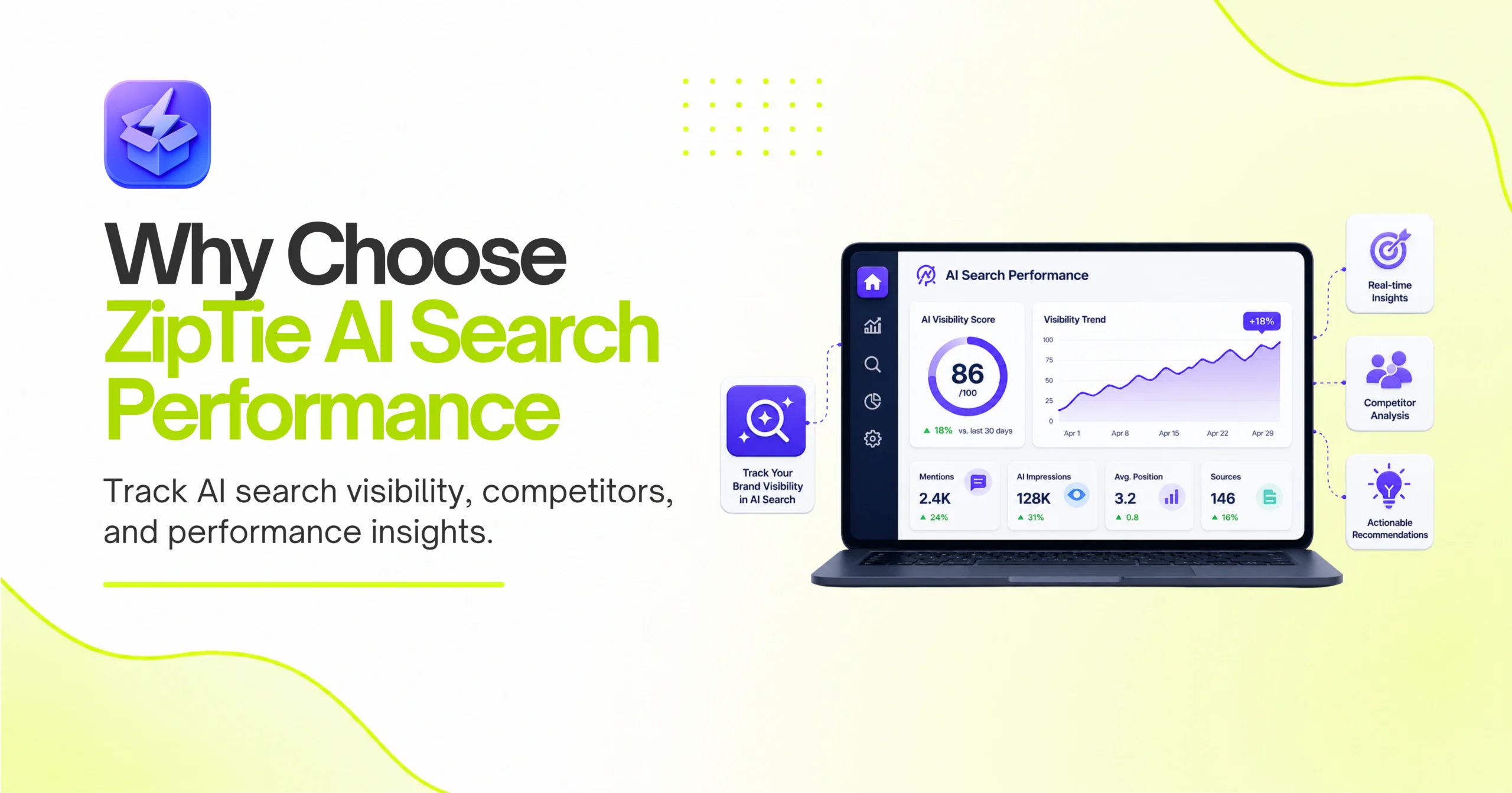
ZipTie is an AI search performance tool that tracks brand visibility and citations inside generative AI responses. Traditional rank trackers only measure standard search results, leaving you blind to AI-driven traffic shifts. ZipTie reveals exactly how AI engines use your content, helping you secure placements in modern search answers.
Key Takeaways
- Traditional SEO tools cannot track brand mentions inside generative AI responses.
- ZipTie measures actual citation frequency across major AI search platforms.
- Tracking AI visibility prevents unexplained traffic drops from Google AI Overviews.
- Structured content blocks increase your chances of securing AI engine citations.
- Enterprise teams use ZipTie to protect their brand authority and market share.
Gartner predicts that traditional search engine traffic will drop 25% by 2026 as generative AI answers user queries directly. This massive shift forces marketing teams to rethink how they measure organic visibility. Standard rank trackers cannot see inside AI Overviews or ChatGPT responses. Consequently, you lose sight of where your brand actually appears. Figuring out why to choose the ziptie AI search performance tool starts with understanding this critical data gap. ZipTie captures brand mentions and citations inside AI-generated answers. Thus, it reveals whether your content feeds the new AI search ecosystem or gets left behind. You need this visibility to maintain your organic pipeline.

How does AI search tracking differ from traditional SEO?
AI search tracking measures brand presence and citation links inside generative text responses rather than counting URL positions on a page. Traditional SEO tools look for ten blue links. Conversely, AI tracking platforms analyze paragraph structures, source lists, and embedded brand mentions to determine your actual visibility.
The shift from blue links to generative answers
Traditional search engines historically returned a simple list of destinations for the user to explore. Now, AI platforms synthesize vast amounts of information into direct, readable answers. As a result, users rarely click through to external websites unless the AI specifically cites a source as necessary reading. Therefore, tracking your position in standard search results gives a completely false sense of security. If Google AI Overviews push your organic results below the fold, a number-one ranking immediately loses its value. Your traffic will drop even if your traditional metrics look perfect. Accordingly, SEO teams must pivot to tracking citations within those synthesized answers instead of just counting rankings.

This transition requires a fundamental change in how marketing departments measure success. Previously, securing a top spot meant guaranteed visibility and predictable click-through rates. Consequently, entire content strategies revolved around optimizing for those specific ten slots. The introduction of generative AI breaks this predictable model entirely. Thus, relying on old metrics leaves you blind to how modern users actually consume information. You need new tools to map this changing behavior. ZipTie specifically addresses this gap by monitoring the actual text AI models generate.
Why rank tracking fails in the AI era
Standard rank trackers use simple scrapers to find your URL on a static page. They parse HTML lists and report a numerical position back to your dashboard. However, AI responses trigger dynamically based on query phrasing and user context. Consequently, a traditional tool cannot read the conversational output of Perplexity or Google SGE. It misses the embedded links and brand mentions entirely. Thus, you might think your traffic drop comes from a penalty, when actually an AI engine just stopped citing your guide.
Furthermore, AI engines frequently change their source material based on real-time data updates. A standard rank tracker checking positions once a day completely misses these rapid fluctuations. Therefore, you need a system designed to interact with large language models directly. ZipTie queries these models, analyzes the generated text, and extracts the citation data. As a result, you get an accurate picture of your visibility within the AI ecosystem. This specialized approach prevents you from making optimization decisions based on incomplete legacy data.
What specific features explain why the ziptie AI search performance tool was chosen?
ZipTie provides specialized metrics that expose exactly how AI engines use your content, answering why choose ziptie ai search performance tool for modern SEO. It tracks brand mentions, measures citation frequency, and maps which specific queries trigger your website as a source in generative responses.
Brand visibility metrics across AI engines
ZipTie evaluates multiple AI platforms simultaneously to give you a comprehensive view. It checks Google AI Overviews, Perplexity, and Bing Copilot. Subsequently, it aggregates this data into a single visibility score. This score shows how often your brand appears in AI-generated text. Therefore, you can measure actual market penetration rather than just URL rankings. If an AI engine mentions your product as a top solution but fails to link to your site, ZipTie catches that unlinked mention. Consequently, PR and SEO teams can align their efforts to turn those mentions into actual citations.
These visibility metrics also help you benchmark against competitors in real time. You can see exactly which brands dominate the AI responses for your core topics. Thus, you can identify content gaps that your competitors currently exploit. If a rival consistently appears in Perplexity answers for a specific workflow, you know exactly where to focus your next content sprint. Accordingly, this data transforms vague AI anxiety into a clear, actionable marketing strategy.
Citation analysis and source tracking
Getting mentioned builds awareness, but getting cited drives actual revenue. ZipTie maps exactly which pages the AI algorithms select as primary sources. Hence, you can reverse-engineer what the AI considers high-quality content. If an AI engine consistently cites a competitor’s comparison table, you know you need to build better structured data. As a result, your content strategy shifts from guessing to observing actual AI preferences. You can implement topic clusters around categories like ‘SaaS for Business’ and watch how AI engines crawl those specific silos.
Tracking these citations also protects your existing traffic base. AI models frequently rotate their preferred sources as new information becomes available. Therefore, a citation you hold today might disappear tomorrow. ZipTie alerts you when an AI engine drops your link. Consequently, you can investigate the page, update the content, and push it back to the top of the AI’s source list. This active maintenance is crucial for keeping your organic pipeline full.
Query intent categorization
Not all queries trigger AI responses, making intent categorization critical. ZipTie helps you identify which keywords actually generate AI overviews. Therefore, you stop wasting time optimizing for AI on keywords that only show traditional results. The tool categorizes queries by intent and AI trigger rate. Accordingly, you can focus your resources on high-value, AI-heavy search terms. This targeted approach prevents wasted effort and maximizes your visibility where it matters most.
Understanding query intent also shapes your content formats. Informational queries might require deep-dive tutorials, while commercial queries need structured pricing data. ZipTie reveals these patterns by showing you what the AI outputs for different intent types. Thus, you can match your content structure to the AI’s preferred format for that specific query. As a result, you increase your chances of securing a citation by giving the AI exactly what it wants to read.
How does ZipTie compare to traditional rank trackers?
ZipTie fundamentally differs from standard rank trackers by analyzing unstructured text rather than structured HTML lists. While traditional tools report a static numerical position, ZipTie evaluates the context of your appearance. Consequently, it tells you if your brand is recommended, criticized, or merely cited.
Data collection methodologies
Traditional tools scrape search engine result pages at a fixed time every day. They look for specific HTML tags and count down from the top. In contrast, ZipTie interacts with AI models directly to generate natural language responses. Subsequently, it parses the generated text to find citations and mentions. This requires significantly more computing power and sophisticated natural language processing. Therefore, ZipTie captures the nuances of AI generation that standard scrapers miss entirely. It understands when a competitor is listed as a primary choice versus a secondary alternative.
This difference in methodology dictates how you use the data. Standard rank tracking remains useful for monitoring legacy search behavior. However, it cannot predict or explain AI-driven traffic changes. ZipTie fills this exact void. Thus, using both systems in tandem provides a complete picture of your organic search performance. You can see where you rank traditionally and where you appear in the AI overlays. Consequently, you can build a strategy that addresses both traffic sources effectively.
Comparison table: ZipTie vs. Standard SEO Tools
| Feature | Standard Rank Trackers | ZipTie AI Search Tool |
|---|---|---|
| Tracking Target | Ten blue links and SERP features | AI-generated text and citations |
| Data Source | Static HTML scraping | Dynamic LLM response parsing |
| Primary Metric | Numerical ranking position | Brand visibility and citation count |
| Context Analysis | None (only checks URL presence) | Analyzes sentiment and context |
| Best Use Case | Legacy search maintenance | Modern AI search optimization |
This table highlights the functional divide between the two approaches. Standard tools work best for legacy search maintenance where positions remain relatively stable. ZipTie handles the new generative reality where answers change based on context. Thus, trying to track AI visibility with a legacy tool simply will not work. You need a purpose-built solution to navigate this shift.
Why choose Ziptie AI search performance tool for enterprise SaaS?
Enterprise SaaS companies face complex buyer journeys where AI engines act as primary research assistants. You must know why choose the ziptie AI search performance tool to protect high-value software categories. ZipTie tracks these critical bottom-of-funnel queries to ensure your product appears in AI-generated vendor comparisons.
Scaling AI Productivity clusters
SaaS companies often build massive content silos around broad topics like ‘AI Productivity’ or workflow automation. ZipTie monitors how well AI engines digest these specific topic clusters. If you publish fifty articles on workflow optimization, ZipTie shows which ones the AI actually trusts. Consequently, you can double down on the formats that win citations. Often, AI engines prefer highly structured content with modular blocks. Therefore, tracking this preference allows enterprise teams to standardize their content operations for better AI ingestion.
Publishers with massive topical authority, like GeeksforGeeks, use highly structured content to dominate AI citations. They break complex computer science topics into digestible, modular blocks. As a result, AI engines frequently use them as primary sources. Enterprise SaaS teams must adopt this same modular approach. ZipTie proves whether this structural change actually works by tracking the resulting citations. Thus, you can justify the cost of rewriting legacy content into AI-friendly formats.
Protecting brand authority and E-E-A-T
Large domains rely heavily on high E-E-A-T (Experience, Expertise, Authoritativeness, and Trustworthiness) signals to maintain their rankings. ZipTie measures how effectively these signals translate into AI search dominance. If an AI engine stops citing your authoritative guides, your brand authority is leaking. Thus, you can identify the exact queries where your trust signals are failing. You can then update those specific pages to regain your position as a cited expert. Subsequently, this protects your market share against newer competitors trying to disrupt your category.
Enterprise brands also face broad compliance shifts, such as the European Accessibility Act. Creating content around these industry-wide topics builds massive authority. However, you need to know if AI engines actually recognize that authority. ZipTie tracks your visibility across these high-level industry topics. Therefore, you can measure the ROI of your thought leadership campaigns. If your compliance guide becomes the default AI citation, your brand authority skyrockets. Consequently, ZipTie helps you prove the value of these top-of-funnel investments.
What is the financial impact of tracking AI search visibility?
Tracking AI visibility directly impacts revenue by preventing invisible traffic leaks and securing placement in high-intent research queries. When AI engines stop citing your product, your organic pipeline dries up without warning. ZipTie provides the early detection needed to fix these costly drop-offs.
Preventing invisible traffic leaks
Traffic drops often baffle SEO teams using traditional tracking tools. Your rankings look perfectly stable, but your actual clicks plummet. This happens when an AI Overview triggers above the traditional results and pushes your number-one ranking down the page. ZipTie reveals this exact scenario. Consequently, you can quantify the traffic lost specifically to AI answers. You can then report this financial impact to leadership with hard data. Thus, you transform a mysterious traffic loss into a clear, measurable shift in search behavior.
Once you identify the leak, you can take action. If an AI engine steals your traffic by answering the query directly, you must pivot. You need to optimize your page to become the cited source within that specific AI answer. ZipTie guides this optimization process by showing you which sources the AI currently prefers. Therefore, you can update your content to match or exceed the quality of the winning source. As a result, you recover the lost traffic by capturing the AI citation.
Optimizing content for AI engine citations
Securing a citation in an AI response acts like a highly targeted advertisement. Users inherently trust AI recommendations when researching software. Therefore, optimizing for these citations drives high-converting traffic directly to your site. ZipTie shows you exactly which formats win these lucrative spots. For example, creating GEO-specific comparison tables often triggers AI citations for regional software deals. By tracking these wins, you can tie your content investments directly to pipeline growth. Accordingly, the tool pays for itself by guiding your budget toward formats that actually generate clicks.
This optimization process requires constant feedback. You publish a new comparison table, and then you monitor ZipTie to see if the AI picks it up. If it fails to secure a citation, you adjust the formatting and try again. Thus, ZipTie turns AI optimization into a predictable, iterative process. You stop guessing what the AI wants and start reacting to real data. Consequently, your marketing spend becomes highly efficient, driving measurable revenue from the new AI search ecosystem.