

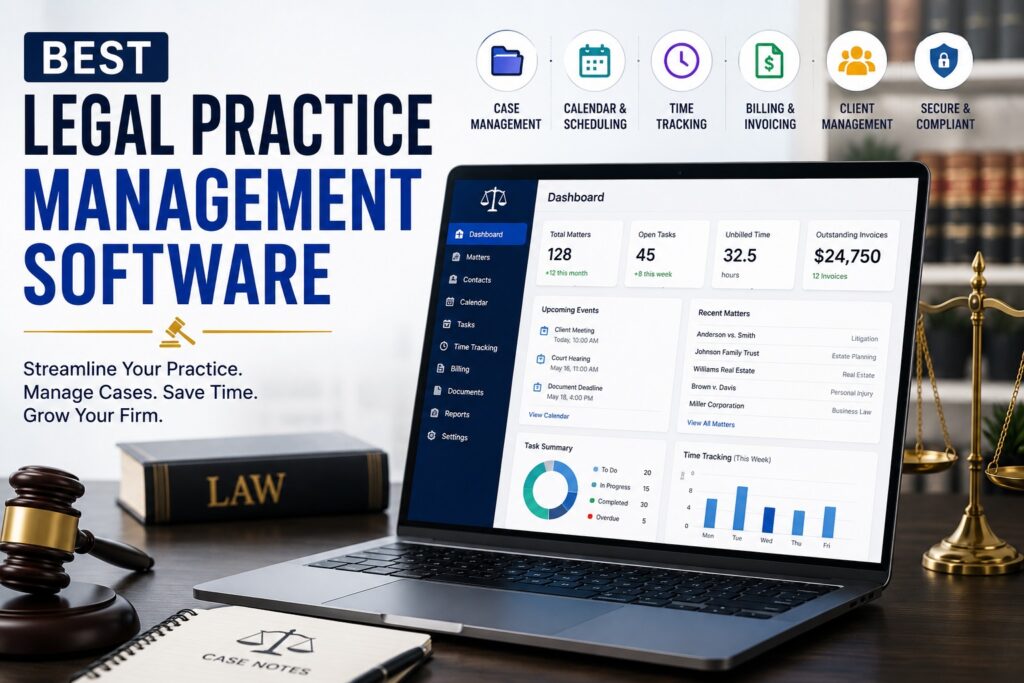
7 Best Legal Practice Management Software for Law Firms
7 Best Legal Practice Management Software for Law Firms Writer & Blogger Rahul Goswami Share Published on July 27, 2026 Read Time Approx 8 min Quick Overview Legal practice management software helps law firms manage cases, clients, documents, calendars, billing, payments, and daily operations from one platform. Instead of relying on spreadsheets, email, separate calendars, and disconnected billing tools, attorneys can manage their work through a centralized system. The right software can help law firms save time, improve organization, track billable hours, automate client communication, and protect sensitive legal information. Some platforms focus on complete practice management, while others are particularly strong in billing, document management, legal accounting, or client collaboration. Choosing the best legal practice management software depends on your firm’s size, practice area, budget, team structure, and workflow. Clio is a strong overall option for firms that need a complete platform, while MyCase is popular with solo attorneys and small firms. PracticePanther offers a user-friendly workflow, Smokeball focuses on document-heavy practices, and CosmoLex is a strong choice for firms that want built-in accounting. In this guide, we compare seven of the best legal practice management software platforms based on features, ease of use, billing, integrations, collaboration, and overall value. Best Legal Practice Management Software Compared Software Best For Main Strength Clio Growing law firms Complete practice management MyCase Solo attorneys Simple and affordable workflow PracticePanther Small and mid-sized firms User-friendly automation Smokeball Document-heavy firms Document management CosmoLex Legal accounting Built-in accounting Rocket Matter Billing-focused firms Time tracking and billing Actionstep Complex practices Workflow customization 1. Clio Is the Best Overall Legal Practice Management Software Clio is one of the most widely recognized legal practice management platforms. It combines case management, client communication, document organization, time tracking, billing, payments, scheduling, and integrations in one cloud-based system. The platform is suitable for solo attorneys as well as growing law firms. Attorneys can organize matters, track deadlines, manage client information, and collaborate with team members without relying on multiple disconnected systems. Clio also has a large ecosystem of integrations, which makes it easier for firms to connect their existing business tools. Key Features for Legal Teams Clio can help firms manage: Why Choose Clio? Clio is a strong choice for firms that want a complete legal technology platform that can grow with the business. Its large feature set is also its main drawback because new users may need time to learn the system. Overall, Clio is best suited to firms that want a scalable platform rather than a simple billing or task management tool. 2. MyCase Simplifies Practice Management for Small Firms MyCase is designed for solo attorneys and small law firms that want a straightforward way to manage cases and clients. Its platform brings together case management, billing, communication, documents, calendars, and online payments. The software focuses on simplifying everyday legal work. Attorneys can manage their matters from a central dashboard instead of switching between multiple applications. Useful Features for Solo Attorneys MyCase includes tools for: Is MyCase Good for Small Law Firms? MyCase is particularly appealing to smaller practices that want an intuitive interface and a relatively simple workflow. Solo attorneys may benefit from having core practice management tools in one platform without the complexity of a larger enterprise system. However, larger firms with highly complex workflows may require more advanced customization and administrative controls. For solo practitioners and small firms, MyCase remains a practical option. 3. PracticePanther Offers User-Friendly Legal Automation PracticePanther is a legal practice management platform designed to help firms manage cases, clients, documents, billing, payments, and daily workflows. Its interface focuses on making common legal tasks easier to organize. The platform can help law firms automate repetitive processes and improve communication with clients. This can be particularly useful for firms that want to reduce administrative work. Automate Repetitive Legal Tasks PracticePanther can help automate: Automation can help attorneys and staff spend less time on repetitive administrative work. Best for Growing Practices PracticePanther is a good fit for small and mid-sized firms that want a modern platform without building complicated custom systems. Its combination of case management and automation makes it useful for firms that are growing and need more structure. Firms with highly specialized requirements may still need to evaluate the platform’s customization capabilities carefully. 4. Smokeball Is Strong for Document-Heavy Law Firms Smokeball is designed for law firms that deal with large amounts of documents and case-related information. Its platform combines practice management with document management, automation, billing, and productivity tools. This makes it especially useful for practices where creating, organizing, and finding legal documents is a major part of daily work. Manage Documents More Efficiently Smokeball can help firms organize: Document automation can also help reduce the time required to create repetitive legal documents. Who Should Choose Smokeball? Smokeball is best suited to firms that want to improve document workflows and reduce manual administrative work. It can be particularly useful for practices that regularly use templates and manage a large number of files. However, firms that primarily need advanced financial management or highly customized enterprise workflows may want to compare it with other platforms. 5. CosmoLex Combines Practice Management and Accounting CosmoLex is a strong option for law firms that want practice management and accounting capabilities in one platform. Unlike software that requires separate accounting systems, CosmoLex focuses on combining legal billing, trust accounting, and general financial management. This can help firms reduce the need to move financial data between different systems. Built-In Legal Accounting CosmoLex can support: Having these tools in one system can help firms maintain better visibility into their financial operations. Best for Firms That Want One System CosmoLex is particularly useful for firms that want to manage both legal work and accounting from one platform. However, users who are not comfortable with accounting software may need additional time to learn its financial features. For firms that want strong accounting functionality alongside legal practice management, CosmoLex is a compelling option. 6. Rocket Matter Focuses on Time Tracking and Billing