


The Quick Read
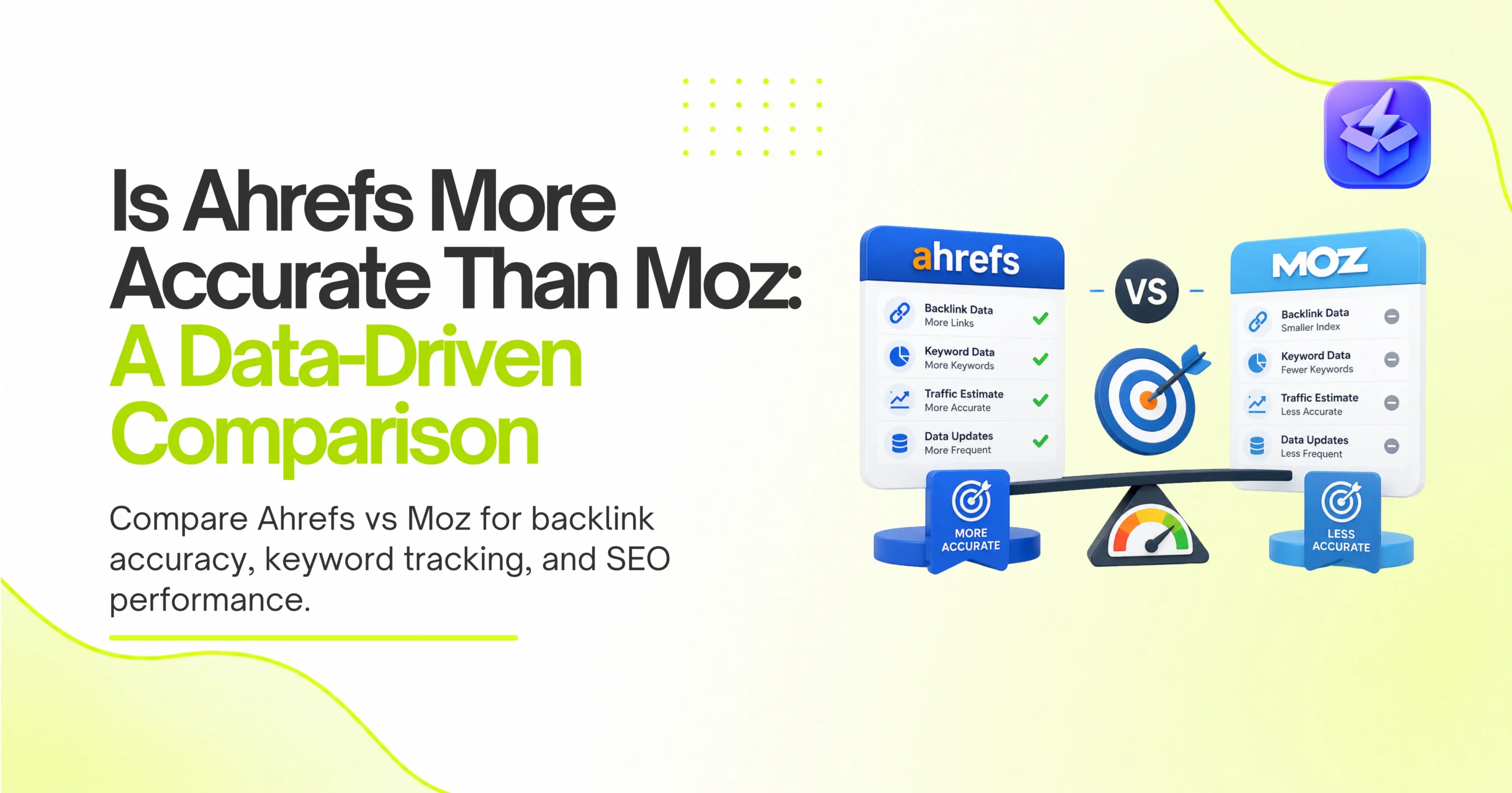
Ahrefs is generally more accurate than Moz for backlink analysis and keyword search volume. Ahrefs operates a significantly larger active web crawler, resulting in faster link discovery and a larger live index. Moz offers reliable proprietary metrics, but Ahrefs provides more precise data for daily SEO campaigns.
Key Takeaways
- Ahrefs finds new backlinks faster due to its massive, continuous web crawling infrastructure.
- Moz excels at broad domain authority scoring but lags in raw active index size.
- Keyword search volumes in Ahrefs rely on blended clickstream data for better precision.
- Technical audits in Ahrefs process JavaScript more reliably than standard Moz crawlers.
Many marketers believe that all major SEO tools pull from the same centralized database to generate their metrics. In reality, each software company builds its own proprietary web index entirely from scratch. When you ask if Ahrefs is more accurate than Moz, you are actually comparing two entirely different server infrastructures. Ahrefs operates one of the most active web crawlers on the internet. This bot rivals the crawl rate of search engines themselves. Moz relies on a more curated, albeit smaller, index called Link Explorer. This fundamental structural difference dictates how quickly you see a new backlink. It determines how accurate a keyword volume estimate feels. It decides whether a technical error gets flagged during an audit. Understanding these mechanical differences helps you allocate your software budget effectively. We test these platforms daily across multiple client campaigns. Consequently, we see exactly where their data aligns and where it diverges wildly.

Link Index Size Dictates Backlink Accuracy
The sheer volume of a tool’s link index determines its backlink accuracy. Ahrefs maintains a live index of trillions of links, updating continuously throughout the day. Moz updates its Link Explorer index regularly, but the total volume of discovered active links remains smaller. Consequently, Ahrefs surfaces new referring domains much faster.
How Ahrefs crawls the web
Ahrefs runs a proprietary crawler called AhrefsBot. This bot visits billions of web pages every single day. Therefore, it captures new backlinks almost as soon as they go live on the internet. If you launch a digital PR campaign on Monday, you will typically see the resulting links in Ahrefs by Wednesday. This rapid discovery cycle makes Ahrefs highly reliable for tracking active link-building efforts. Accordingly, SEO professionals trust Ahrefs to monitor immediate campaign performance and report to clients. The platform categorizes links into live, recent, and historical indices. This segmentation allows users to filter out lost links quickly. You can see exactly when a link dropped and investigate why.

Moz approaches link discovery differently.
Moz handles link indexing differently through its Link Explorer infrastructure. Instead of trying to crawl every corner of the internet constantly, Moz focuses heavily on high-quality domains. This means Moz might miss links from smaller, newer websites initially. If you get a backlink from a brand-new blog, Moz often takes weeks to report it in your dashboard. However, Moz filters out a lot of spam automatically through this curated approach. Some users prefer this cleaner, curated view of their backlink profile. They want to see links that actually move the needle for their rankings. Nevertheless, when you need a complete picture of your backlink profile, a curated list falls short. You need raw data to make informed decisions about disavow files and competitor link gaps.
Keyword Volume Estimates Show Distinct Variances
Keyword accuracy depends heavily on how a platform processes search volume data. Ahrefs blends Google Keyword Planner data with clickstream data to refine its volume estimates. Moz relies more heavily on traditional Keyword Planner ranges. As a result, Ahrefs typically provides more realistic search volume numbers for niche queries.
Clickstream data versus Google Ads
Google Keyword Planner groups similar keywords together by default. It shows the same search volume for “SEO tools” and “toolsfor SEO”. Ahrefs breaks these groupings apart using clickstream data. Clickstream data comes from browser extensions that track real user behavior across the web. Consequently, Ahrefs can show you that “SEO tools” gets 10,000 searches while “tool for SEO” gets only 500. This un-grouping feature is crucial for content planning. You need to know the exact phrasing users prefer before writing an article. Moz tends to stick closer to Google’s grouped data. Therefore, Moz might overestimate the potential traffic of a specific long-tail variation. When deciding if Ahrefs is more accurate than Moz for keyword research, this un-grouping capability remains the deciding factor.
Long-tail keyword precision
Long-tail keywords drive the majority of targeted organic traffic for most websites. Ahrefs excels at identifying these low-volume, high-intent phrases. The platform updates its keyword database monthly across hundreds of countries. This frequent updating catches new trending terms quickly. If a new software category emerges, Ahrefs shows the search volume within weeks. Moz updates its keyword data less frequently. You might wait months to see accurate data for a newly coined industry term. For instance, teams tracking AI search trends need immediate data to stay competitive. If you use tools like the ZipTie AI Search Performance Tool, you already know how fast search behavior shifts. Ahrefs keeps pace with these rapid shifts much better than Moz.
Domain Authority Metrics Serve Different Purposes
Proprietary domain metrics attempt to predict how well a website will rank. Moz created the original Domain Authority (DA) metric, which remains an industry standard. Ahrefs uses Domain Rating (DR), focusing strictly on backlink profile strength. While both score sites out of 100, they measure entirely different signals.
Domain Rating mechanics in Ahrefs
Ahrefs calculates Domain Rating purely based on link equity. If a high-DR site links to you, your DR increases. If that site links to thousands of other sites, the equity dilutes. DR ignores on-page SEO, traffic, and content quality entirely. Because DR relies on pure math, it is highly volatile but completely transparent. You can usually look at a site’s backlink profile and understand exactly why its DR changed. This transparency helps link builders set clear targets. They know exactly how many high-DR links they need to move their own metric. Consequently, DR has become the default currency in the link-building industry.
Domain Authority calculations in Moz
Moz calculates Domain Authority using a complex machine-learning model. DA looks at multiple factors, including link counts, linking root domains, and spam scores. Moz attempts to predict actual search engine ranking potential. Therefore, DA fluctuates based on Moz algorithm updates, not just your backlink acquisitions. If Moz updates its model, your DA might drop even if you gained links. This makes DA a more holistic metric, but a frustrating one for tracking direct progress. Many agencies still report on DA because clients recognize the term. However, when evaluating if Ahrefs is more accurate than Moz, you must understand that these metrics are not interchangeable. They measure different realities.
GEO-Specific Comparison Data Reveals Local Accuracy
International SEO requires accurate data across multiple geographic regions. Ahrefs maintains distinct keyword databases for 243 countries, updating regional search volumes independently. Moz offers reliable US data but struggles with smaller international markets. Consequently, global campaigns require the depth of Ahrefs to accurately forecast regional traffic.
Regional keyword databases
Ahrefs allows you to separate keyword research by specific countries easily. You can see how a term performs in the UK versus Australia instantly. The platform collects clickstream data globally, ensuring local nuances are reflected in the search volume. For example, a SaaS company targeting Europe needs exact search volumes for Germany and France. Ahrefs provides this granularity. Moz often falls back on broader estimates for non-US markets. If you build a localized content strategy, inaccurate data leads to wasted resources. You might write a detailed guide for a keyword that nobody searches in that specific country.
Tool versus tool feature comparison
To understand the practical differences, we must look at how these tools handle specific tasks. We built a comparison of their core capabilities for international campaigns.
| Feature Area | Ahrefs Capability | Moz Capability | Accuracy Winner |
|---|---|---|---|
| Live Link Index | ~35 Trillion Links | ~43 Trillion (Total) | Ahrefs (Faster updates) |
| Keyword Database | 19.2 Billion Terms | ~500 Million Terms | Ahrefs (Broader scope) |
| Supported Regions | 243 Countries | 170 Countries | Ahrefs (More local data) |
| Spam Analysis | Manual review | Automated Score | Moz (Built-in metric) |
This table highlights why enterprise teams often prefer Ahrefs for global work. The sheer volume of data available makes a measurable difference in campaign planning. You can structure your software deals into seo topic clusters much more effectively when you have accurate local data. Accordingly, Ahrefs wins the international accuracy test.
Site Auditing Capabilities Expose Technical Depth
Technical SEO requires a crawler that mimics real search engine behavior. The Ahrefs Site Audit tool executes JavaScript natively, uncovering hidden links and dynamic content issues. Moz Pro offers a solid crawler for standard HTML sites, but struggles with complex JavaScript frameworks. Ahrefs captures technical errors more accurately.
JavaScript rendering speed
Modern websites rely heavily on JavaScript frameworks like React and Angular. Search engines render this code to understand the final page layout. Ahrefs renders JavaScript by default during its site audits. Therefore, it finds broken links hidden inside dynamic menus. It sees content loaded via client-side rendering. Moz requires specific configurations to handle JavaScript, and even then, it often misses dynamically injected elements. If you audit a modern web application, you need a tool that sees what Google sees. Ahrefs provides this visibility out of the box. This saves technical SEOs hours of manual testing.
Issue prioritization logic
Both platforms flag technical issues like broken links, missing meta descriptions, and redirect chains. However, Ahrefs categorizes these issues by potential impact. It groups errors, warnings, and notices clearly. You can see exactly which issues affect your organic traffic most. Moz presents a flatter list of issues. You have to decide which problems deserve immediate attention. When managing large websites, prioritization is critical. You cannot fix every single notice. You must focus on the errors that actually harm your rankings. Ahrefs makes this triage process much faster and more accurate.
Why Is Ahrefs More Accurate Than Moz For Competitor Analysis
Competitor analysis demands precise historical data and traffic estimations. Ahrefs tracks historical rankings across millions of keywords, allowing you to reverse-engineer a competitor’s exact growth strategy. Moz provides snapshot data but lacks deep historical traffic trends. Consequently, Ahrefs delivers a more accurate picture of competitor performance.
Update frequency and index freshness
To analyze a competitor, you need fresh data. If a competitor launches a new product page, you want to know what keywords it ranks for immediately. Ahrefs updates its organic traffic estimates daily for high-volume keywords. You can watch a competitor’s traffic spike in real-time. Moz updates its SERP data less frequently. You might not see a competitor’s new rankings for several weeks. In highly competitive industries, a few weeks of delay costs you market share. You need to react to competitor moves quickly. Therefore, the freshness of Ahrefs data gives you a distinct tactical advantage.
Historical data retention
Ahrefs stores years of historical ranking data. You can look at a competitor’s traffic graph from 2018 to today. This view shows exactly which algorithm update hit them. It also pinpoints the exact month they started aggressively building links. Moz does not offer this level of historical granularity in its standard interface. Having access to historical data allows you to spot long-term trends. You can see if a competitor’s current success is a temporary spike or the result of a multi-year strategy. When clients ask if Ahrefs is more accurate than Moz, this historical context is a major factor. Accurate data requires historical context.
Evaluating Content Gap Opportunities
Content gap analysis identifies keywords your competitors rank for, but you do not. Ahrefs features a dedicated Content Gap tool that compares your domain against multiple competitors simultaneously. Moz offers a similar keyword intersection feature. However, Ahrefs processes a much larger keyword database, revealing more hidden opportunities.
Multi-domain comparisons
Ahrefs lets you input up to ten competitor domains at once. The tool cross-references their rankings against your site. It then outputs a prioritized list of keywords where at least three competitors rank, but you are nowhere to be found. This specific filter eliminates outlier keywords. It focuses your attention on industry-standard topics you missed. Moz allows domain comparisons, but the interface is less intuitive for bulk analysis. You often have to export data to spreadsheets to find the real gaps. Ahrefs handles the heavy lifting inside the application. This efficiency makes content planning significantly faster.
SERP feature analysis
Modern search results contain featured snippets, “People Also Ask” boxes, and video carousels. Ahrefs tracks these SERP features alongside traditional rankings. When you run a content gap analysis, Ahrefs shows you if a keyword triggers a featured snippet. This helps you format your content correctly. If the target keyword shows a video carousel, you know you need to produce a video, not just a blog post. Moz tracks SERP features as well, but Ahrefs integrates this data more seamlessly into its content planning workflows. Knowing the exact format required to rank improves your strategic accuracy. Thus, you build better content clusters.