
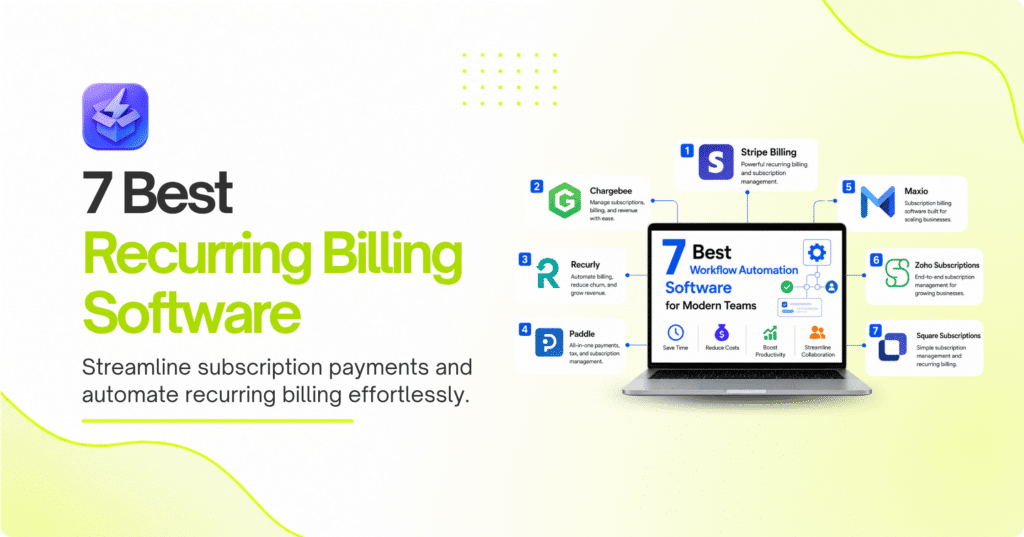
7 Best Recurring Billing Software for Subscription Businesses
Writer & Blogger
Rahul Goswami
Share
Published on
Read Time
Approx 8 min
Recurring billing software helps businesses automate subscription payments, recurring invoices, renewals, payment collection, and customer billing. Instead of manually creating invoices or following up on every upcoming payment, businesses can use recurring billing platforms to automate the entire payment cycle.
This type of software is particularly useful for SaaS companies, subscription businesses, membership platforms, agencies, professional services, and other businesses that charge customers on a recurring basis. Depending on the platform, businesses can support monthly, quarterly, annual, usage-based, or customized billing models.
The best recurring billing software depends on your business model, payment requirements, pricing structure, integrations, and expected growth. Stripe Billing is a strong option for businesses already using Stripe, while Chargebee is designed for subscription businesses with more complex billing requirements. Recurly focuses heavily on subscription management, Paddle is useful for SaaS companies, and Maxio provides strong subscription management and revenue operations capabilities. Zoho Subscriptions is a practical option for smaller businesses, while Square Subscriptions can work well for businesses already using Square’s payment ecosystem.
In this guide, we compare seven recurring billing platforms based on subscription management, automation, payment processing, invoicing, integrations, scalability, and overall usability.
Best Recurring Billing Software Compared
| Software | Best For | Main Strength |
|---|---|---|
| Stripe Billing | Flexible subscription businesses | Payment and billing infrastructure |
| Chargebee | Complex subscriptions | Advanced subscription management |
| Recurly | Subscription businesses | Recurring revenue management |
| Paddle | SaaS companies | Billing and payment infrastructure |
| Maxio | B2B SaaS | Subscription and revenue management |
| Zoho Subscriptions | Small businesses | Simple subscription billing |
| Square Subscriptions | Small businesses | Easy recurring payments |
1. Stripe Billing Is Best for Flexible Recurring Payments
Stripe Billing is a recurring billing solution built into the broader Stripe payments ecosystem. It allows businesses to create subscription plans, collect recurring payments, manage invoices, and support different pricing models.
One of Stripe Billing’s biggest advantages is flexibility. Businesses can create simple recurring subscriptions as well as more customized pricing structures. This makes it suitable for SaaS companies, online services, marketplaces, and other businesses where billing requirements can change as the company grows.
Stripe also provides a broad developer ecosystem, making it particularly attractive to businesses with technical teams. Developers can integrate billing functionality directly into websites and applications and connect it with other Stripe services.
For businesses already using Stripe for payment processing, adding recurring billing can create a more unified payment infrastructure.
Key Features for Subscription Businesses
Stripe Billing can support:
- Recurring subscriptions
- Automated invoices
- Payment collection
- Multiple pricing models
- Subscription management
- Customer billing portals
- Payment retries
- Revenue-related reporting
- Developer APIs
- Third-party integrations
Why Choose Stripe Billing?
Stripe Billing is a strong choice for businesses that want flexibility and developer control. It can support both straightforward subscriptions and more customized billing workflows.
The platform may require more technical involvement than simpler subscription billing products. Businesses without developers may therefore prefer a platform with more built-in configuration and less implementation work.
2. Chargebee Handles Complex Subscription Models
Chargebee is designed specifically around subscription management and recurring revenue. It provides businesses with tools for managing subscriptions, plans, invoices, payments, and customer lifecycle events.
The platform can be useful for businesses that have moved beyond simple monthly or annual subscriptions. Companies can manage different plans, pricing structures, upgrades, downgrades, renewals, and other subscription changes from a centralized system.
Chargebee is particularly relevant to SaaS and subscription companies because recurring revenue often becomes more complicated as the customer base grows. A business may need multiple pricing tiers, trials, discounts, add-ons, or billing schedules.
Subscription Features
Chargebee provides capabilities such as:
- Subscription management
- Recurring invoices
- Pricing and plan management
- Customer management
- Payment collection
- Trials and discounts
- Subscription upgrades and downgrades
- Revenue reporting
- Payment gateway integrations
Is Chargebee Right for Growing Businesses?
Chargebee is a strong option for businesses that expect their subscription model to become increasingly sophisticated. Its focus on recurring revenue makes it more specialized than basic invoicing software.
However, smaller businesses with only a few simple subscription plans may not need its full range of capabilities. In those cases, a simpler billing platform can be easier to configure and manage.
3. Recurly Focuses on Subscription Management
Recurly is a subscription billing platform built to help businesses manage recurring revenue and customer subscriptions. It provides tools for recurring payments, subscription plans, invoices, customer management, and payment recovery.
Subscription businesses often face problems when customers’ payments fail. Recurly focuses on helping businesses manage these situations through automated payment recovery and subscription lifecycle tools.
The platform can support different subscription structures, making it useful for businesses that need more flexibility than a simple recurring invoice system provides.
Key Features for Recurring Revenue
Recurly includes features such as:
- Subscription management
- Recurring payments
- Automated billing
- Invoice management
- Payment recovery
- Customer management
- Subscription plan management
- Reporting and analytics
- Payment integrations
Why Consider Recurly?
Recurly is a good fit for businesses where subscription management is central to their revenue model. Its focus on recurring revenue can help companies organize billing operations as their subscriber base grows.
The platform is more specialized than basic payment tools, so businesses with very simple billing needs may find simpler alternatives easier to operate.
4. Paddle Is Useful for SaaS Subscription Businesses
Paddle provides billing and payment infrastructure with a particular focus on software and SaaS businesses. It can help companies manage subscriptions, payments, invoices, and customer billing from a centralized platform.
For SaaS companies selling software internationally, billing can involve more than simply collecting a monthly payment. Businesses may need to manage different currencies, taxes, payment methods, subscriptions, and customer lifecycle events.
Paddle is designed to simplify many of these billing responsibilities. This can allow software companies to focus more on their product while using a specialized platform for payment and subscription operations.
Key Features
Paddle offers capabilities around:
- Subscription billing
- Recurring payments
- Invoicing
- Payment processing
- Customer management
- Pricing plans
- Subscription lifecycle management
- Global payments
- SaaS billing workflows
Who Should Choose Paddle?
Paddle is particularly attractive to SaaS businesses that want billing and payment infrastructure designed around software subscriptions.
Companies with unusual billing requirements should still evaluate the platform’s supported pricing and payment models before making a decision.
5. Maxio Is Built for B2B SaaS Billing
Maxio focuses on subscription management and financial operations for B2B SaaS companies. Its platform is designed for businesses dealing with recurring revenue, subscription contracts, billing, and revenue management.
B2B SaaS billing can become complicated when companies introduce annual contracts, multiple products, usage-based pricing, discounts, upgrades, and other commercial arrangements. Maxio is designed to help businesses manage these types of subscription and revenue workflows.
The platform goes beyond simple recurring payments by connecting subscription management with broader financial processes.
Key Features for SaaS Companies
Maxio provides capabilities including:
- Subscription management
- Recurring billing
- Usage-based billing
- Invoicing
- Revenue management
- Customer management
- Financial reporting
- SaaS metrics
- Integrations
Is Maxio Worth Considering?
Maxio is particularly suited to B2B SaaS businesses that have more complex subscription and revenue requirements. Its focus on SaaS financial operations can be valuable as a company grows.
Smaller businesses with straightforward monthly subscriptions may not need such a specialized platform. The more complex your pricing and revenue model becomes, the more useful a platform like Maxio can be.
6. Zoho Subscriptions Is Good for Small Businesses
Zoho Subscriptions is a subscription billing platform designed to help businesses manage recurring billing, customer subscriptions, invoices, and payments.
It can be particularly attractive to small and growing businesses that want a straightforward subscription management system without building their own billing infrastructure.
The platform also fits naturally into the broader Zoho ecosystem, which can be useful for businesses already using Zoho applications for CRM, accounting, customer management, or other business processes.
Key Features for Small Businesses
Zoho Subscriptions supports:
- Recurring billing
- Subscription management
- Automated invoices
- Payment collection
- Customer management
- Multiple billing cycles
- Payment gateway integrations
- Reporting
- Zoho ecosystem integrations
Why Choose Zoho Subscriptions?
Zoho Subscriptions can be a practical choice for small businesses that want centralized subscription management and already use other Zoho products.
Its main advantage is simplicity and ecosystem integration. Businesses with highly specialized enterprise billing requirements may need a more advanced subscription management platform.
7. Square Subscriptions Makes Recurring Payments Simple
Square is widely used by small businesses for payment processing, and its subscription capabilities can help businesses accept recurring payments from customers.
Square Subscriptions can be useful for businesses that already use Square for payments and want to add recurring billing without introducing an entirely separate billing ecosystem.
This can be particularly convenient for service businesses, memberships, and other organizations that charge customers regularly.
Key Features
Square’s recurring payment capabilities can support:
- Recurring payments
- Subscription plans
- Customer management
- Automated billing
- Payment processing
- Online payment options
- Integration with the Square ecosystem
Who Should Choose Square?
Square can be a good option for small businesses that already rely on Square for payment processing and want a straightforward way to add recurring payments.
Businesses with sophisticated SaaS billing models, usage-based pricing, or complex subscription operations may need a specialized platform such as Chargebee, Recurly, or Maxio.
How to Choose the Best Recurring Billing Software
The best recurring billing software depends on the complexity of your subscription model, payment requirements, customer base, and existing business software.
Start by identifying how customers are charged. If you only need monthly or annual subscriptions, a simple platform may be sufficient. However, businesses using usage-based pricing, multiple plans, discounts, trials, add-ons, or complex contracts should look for more advanced subscription management capabilities.
Payment processing is another important consideration. Check whether the platform supports the payment methods, currencies, regions, and gateways your customers require.
Compare Billing and Automation Features
Before choosing a platform, consider:
- Recurring payments
- Automated invoicing
- Subscription management
- Failed-payment recovery
- Pricing plans
- Usage-based billing
- Discounts and trials
- Customer portals
- Payment gateways
- Reporting
- Integrations
Automation should also be a priority. The goal of recurring billing software is not simply to generate another invoice. It should reduce manual work throughout the subscription lifecycle.
Consider Scalability and Integrations
Your billing system should be able to grow with your business. A platform that works for 100 subscribers may not be appropriate when you have thousands or millions of customers.
Consider how easily the software integrates with your accounting platform, CRM, customer support tools, analytics systems, and payment infrastructure.
For SaaS businesses, also consider whether the platform can handle upgrades, downgrades, prorations, usage-based charges, annual contracts, and other subscription changes.
Final Thought
The best recurring billing software can automate one of the most important parts of a subscription business: collecting revenue consistently. Stripe Billing is a strong option for businesses that want flexible payment and billing infrastructure, while Chargebee is well suited to companies managing complex subscription models.
Recurly focuses heavily on subscription management and recurring revenue, while Paddle is particularly useful for SaaS businesses looking for billing and payment infrastructure. Maxio is a strong option for B2B SaaS companies with more sophisticated subscription and revenue requirements.
For smaller businesses, Zoho Subscriptions provides an approachable subscription billing solution, while Square Subscriptions can be convenient for businesses already using the Square ecosystem.
There is no single platform that works best for every business. Before choosing software, evaluate your pricing model, payment requirements, customer volume, integrations, automation needs, and future growth.
The right recurring billing platform should reduce manual billing work, improve payment collection, make subscription management easier, and give your business room to scale.
FAQ
What is recurring billing software?
Recurring billing software automates subscription payments, recurring invoices, renewals, payment collection, and other billing activities for businesses that charge customers regularly.
Which recurring billing software is best?
The best option depends on your business. Stripe Billing is a flexible choice, Chargebee and Recurly are strong for subscription businesses, Paddle is useful for SaaS, and Zoho Subscriptions can work well for smaller businesses.
Can recurring billing software handle failed payments?
Many recurring billing platforms provide payment recovery features that can automatically retry failed transactions or notify customers about payment problems.
Can recurring billing software support different subscription plans?
Yes. Most dedicated subscription billing platforms allow businesses to create multiple plans and manage upgrades, downgrades, renewals, trials, discounts, and other subscription changes.
Is recurring billing software useful for SaaS companies?
Yes. SaaS businesses are among the primary users of recurring billing software because they commonly charge customers monthly or annually and need to automate subscription management.
What should I consider before choosing recurring billing software?
Consider pricing, payment gateways, subscription management, automation, failed-payment recovery, integrations, reporting, scalability, supported currencies, and whether the platform fits your specific billing model.